How to grow Cymbidium sinense 'Jinbian'? A detailed guide to pot cultivation methods
Cymbidium sinense has now become one of the more popular Chinese orchids in our country. In Taiwan, China, it has entered thousands of households, used to decorate indoor environments and as the main ceremonial potted flower for gifting to relatives and friends. The flower stems are also used for flower arranging. If Cymbidium sinense is used as the main material, paired with rhododendron, Spiraea cantoniensis, Callicarpa, Hydrangea, and Panicum, it can present a picture full of vitality.
The leaves of Cymbidium sinense 'Jinbian' are wider than ordinary orchid leaves, with yellow edges on both sides of the leaf and some yellow stripes in the middle. Its flowers are dark red with a slight purple tinge, and the flower shape is somewhat irregular; a small number of petals are flat and straight, while most are curved, just like the technique of modern abstract artists in painting.
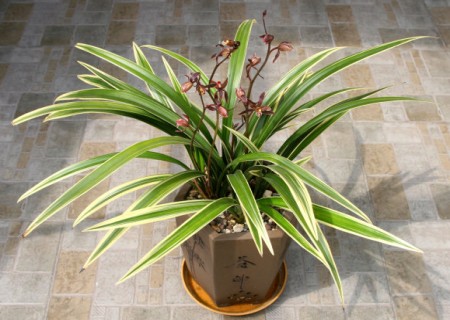
In addition, there is an unusual type of orchid called leaf-art orchid. The so-called "art" mainly refers to variation in orchid leaves, such as leaf width, stripes or spots in the leaves, etc. "Art" is obtained through selection and cultivation. It is said that "art" will degenerate from generation to generation. Jinbian implies "art". This orchid already has three generations in the same pot, and the orchid leaves of each generation have golden edges, indicating that the "art" is very stable.
How do you grow Cymbidium sinense 'Jinbian'? The following explains the maintenance and management methods for potted Cymbidium sinense 'Jinbian':
From August to September, take larger clumps of plants out of the pot and divide them into clumps of 3-4 pseudobulbs for potting. The potting medium commonly used is decomposed bark chunks, peat soil and leaf mold. Pay attention to cleanliness when watering, and avoid spraying directly with tap water. In midsummer, water once a day. In winter, water once every 4-5 days. Room temperature should not be too high, otherwise it is prone to disease in spring. During the growing season, fertilize once a month; prevent drought in autumn, and the potting soil should not be too wet in winter.
Cymbidium sinense 'Jinbian' is a semi-shade plant and requires environmental conditions of "warmth, humidity, diffused light, and ventilation". Whether it grows well depends entirely on maintenance and management. The cultivation site requires good ventilation and shade facilities. In summer, Cymbidium sinense should be shaded, and the plant should be ensured to receive appropriate direct sunlight; otherwise the plant will grow poorly and develop poorly. However, make sure the plant receives sunlight before 10 a.m. every day, and avoid direct sunlight at noon and in the afternoon, otherwise it is not conducive to the normal growth of the plant.
The water requirements of Cymbidium sinense 'Jinbian' mainly depend on temperature, light intensity and plant growth. Gao Lian of the Ming Dynasty said in the appendix to "Lan Pu", in "Four Precepts for Cultivating Orchids": "Do not take them out in spring, do not expose them to the sun in summer, do not let them dry out in autumn, and do not keep them wet in winter." These twelve characters are indeed the experience of growing orchids.
For watering Cymbidium sinense 'Jinbian', rainwater or snow water is best. If tap water must be used to water orchids, it must be exposed to the sun for a day before use. Use a watering can for watering, and do not spray water into the flower buds, so as to avoid rot. In summer, never let rain showers wash over them; plastic film must be used to block rain. As for watering time, in summer and autumn, water around sunset, and it is best for the leaf surface to dry before nightfall. In winter and spring, watering around sunrise is best, and misting should also be done to increase air humidity to facilitate the growth of Cymbidium sinense.
Cymbidium sinense has a low demand for fertilizer, and the plant can still grow well without base fertilizer. Each year in spring and autumn, water the plant once with dilute liquid fertilizer. Topdressing should be stopped during the dormant period. When fertilizing Cymbidium sinense 'Jinbian', "it is better to be light than concentrated"; generally start in late spring and stop in late autumn.
When fertilizing, a temperature of 18°C-25°C is suitable, and fertilizing is not suitable on cloudy and rainy days. As for fertilizer types, either organic fertilizer or inorganic fertilizer can be used. During the growing season, fertilize once a week. In autumn and winter, Cymbidium sinense 'Jinbian' grows slowly, so fertilize less, once every 20 days. After fertilizing, spray a small amount of clean water to prevent the fertilizer solution from staining the leaves. Fertilizing must be done on clear evenings; fertilizing on cloudy days risks root rot.