How to grow potted Cymbidium sinense? Detailed guide to cultivation methods and precautions
As one of the most famous Chinese orchids in our country, Cymbidium sinense is certainly something we want to admire. In fact, it has many elegant names, such as Baosui Lan and Rusui Lan, all carrying meanings of good fortune and blessings. Its leaves are strap-shaped, very thin, dark green, and slightly leathery, which is why it is called Mo Lan (Ink Orchid). Chinese Cymbidium sinense has elegant flowers and leaves, refined flower posture, and a delicate lingering fragrance. It enjoys the reputation of “King of Fragrance” and “Gentleman Among Flowers.” It can be said to have a uniquely charming appeal, and it is inevitable that it will tempt you to try growing it.
Cymbidium sinense is also called orchid soil, and is suitable for planting in soil rich in humus, loose and non-sticky, which is more favorable for its growth. So when transplanted into indoor pots as an indoor ornamental plant, the cultivation methods of Cymbidium sinense have become a concern for many consumers. When growing flowers, one should understand the cultivation methods and precautions for Cymbidium sinense.
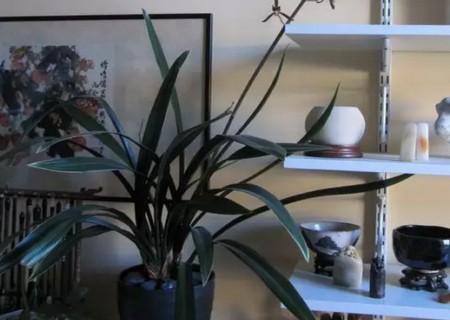
1. Environment
Cymbidium sinense likes an environment with circulating air. When ventilating under relatively low humidity, it is best to spray water at the same time, which helps increase air humidity and prevent leaf tip drying. Its leaves are long and thin with many stomata and a large contact surface with air, so it especially needs a fresh, pollution-free growing environment.
2. Soil
Potted orchids mostly use humus soil from under the forests of their place of origin, locally called “orchid soil.” This soil is rich in humus, loose and non-sticky, often slightly acidic, and is an excellent potting soil for cultivating orchids. Cymbidium sinense likes a slightly moist soil environment and should not be subjected to drought. The water used should preferably be soft water.
3. Light
In summer, Cymbidium sinense should be shaded, and the plant should still be ensured appropriate direct sunlight, otherwise the plant will grow poorly and develop poorly. However, the plant should be ensured sunlight exposure before 10 a.m. each day, avoiding direct sunlight at noon and in the afternoon, otherwise it is not conducive to normal growth and development. Too strong light easily sunburns the leaves and causes sunscald. Excessive shading or long-term placement indoors will also affect the orchid's photosynthesis, causing poor growth and difficulty in blooming. In short, under the premise of ensuring the orchid leaves are not scorched, appropriate exposure to more sunlight, especially morning light before 9 a.m., is very beneficial to orchid growth and blooming.
4. Temperature
Cymbidium sinense likes a warm environment and grows well within a temperature range of 16°C to 28°C. The suitable growth temperature for Cymbidium sinense is 18°C to 28°C. In summer, if it exceeds 30°C, or in winter if the average temperature is below 10°C, growth slows or it enters dormancy. When the temperature is above 35°C, the orchid plant will show dried or curled leaves; below 5°C, it may suffer frost damage. In mild cases, red-purple patches appear on the leaves; in severe cases, the leaves freeze to death or even the whole plant dies.
5. Humidity
The most suitable temperature for Cymbidium sinense growth is between 20-28 degrees. If below 20 degrees, its growth rate slows; if above 25 degrees, its growth rate becomes too fast. At 30 degrees, it enters dormancy. Cymbidium sinense likes a growing environment where the potting soil is slightly dry and the air humidity is high. Therefore, when planting Cymbidium sinense, one should artificially create a relative humidity of 55%-75% during the day and no less than 80% at night. Measures such as humidifiers, automatic misting, hanging water curtains, sprinkling water on the ground, and setting up water pools or water basins to increase humidity can be used.
6. Watering
As the saying goes, “Understanding orchid growing takes a moment, but mastering watering takes three years.” For Cymbidium sinense, rainwater or snow water is best. If tap water must be used, it must be exposed to the sun for a day before use. When watering Cymbidium sinense, do not water too much or too little. There should be no standing water in the pot, as this will cause root rot. Be careful when watering not to pour water into the leaf center, as this will cause the leaf center to rot. In midsummer, water once a day. In winter, water once every 4-5 days.
7. Fertilizing
Cymbidium sinense has a low demand for fertilizer, and the plant can grow well even without base fertilizer. Each year in spring and autumn, apply dilute liquid fertilizer once to the plant. Stop topdressing during dormancy. Fertilizing Cymbidium sinense should be “light rather than concentrated,” generally starting in late spring and stopping in late autumn. Fertilizing is best when the temperature is 18-25°C, and should not be done on rainy days. As for fertilizer types, both organic and inorganic fertilizers are acceptable.
8. Pest and Disease Control
When exposed to too much sunlight in summer, the plant is prone to sunscald. Its symptoms are yellow spots appearing on the leaf surface, which gradually turn black, and in severe cases the entire leaf dries up and dies. The control method is to avoid prolonged direct sunlight and provide timely shading. In balcony cultivation, Cymbidium sinense is prone to root rot and is often attacked by pests such as scale insects and ants.
9. Placement Location
Cymbidium sinense can be placed on east-facing, south-facing, and west-facing balconies for management, among which east-facing and west-facing balconies give better cultivation results. On south-facing balconies, areas with too strong sunlight should be avoided. Because it is moderate in height, it can be placed on various balconies of different sizes. During its vigorous growth stage, place the plant where it receives at least 1-2 hours of scattered sunlight daily. In summer, the environment should remain ventilated. Slightly lower temperatures in winter are not a problem.
Precautions:
1. Maintain relatively high air humidity. During the growth period, frequently spray water on the plant's branches, leaves, and surrounding environment. Especially in high-temperature weather when air humidity is too low, spraying should be strengthened. However, during rainy seasons when air humidity is too high, spraying should be strictly prohibited to prevent various diseases.
2. Maintain a relatively shaded environment. There can be short periods of sunlight in the early morning and at dusk to promote rapid and robust growth of new orchids. Apart from that, a shaded environment should be maintained.
3. Water correctly. When watering, grasp the principle of keeping the potting soil moist but not overly wet, that is, water when the surface soil is dry but the lower soil is still slightly moist. When watering, water thoroughly rather than only halfway. In rainy weather, move the orchid pot to a place sheltered from rain and promptly pour out standing water. In winter, when Cymbidium sinense is in bud and about to bloom, it also needs appropriate watering; being too dry is unfavorable to its growth and blooming.
4. Master the fertilizing principle. Follow the fertilizing principle of “frequent but light, and avoid sudden heavy applications.” Never apply concentrated fertilizer, otherwise it will damage the roots and affect plant growth.