How to grow and care for a potted Guzmania bromeliad
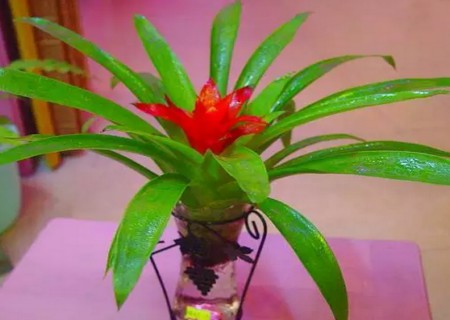
Guzmania is a very beautiful indoor potted flowering plant that offers both attractive flowers and foliage. With its distinctive rosette growth habit, bright spike-like inflorescence and long blooming period, it has gradually become a “favourite” in the flower market. Its brilliant red colouring in particular gives a lively impression, making it especially suited to people who love a vibrant feel. What's more, Guzmania can be called a premium among flowers, showing off the owner's good taste. Grown in keeping with the home's decor, it adds a beautiful touch to the scene. Imagine how pleasing it is to see such lovely flowers every day. A pot of Guzmania brings you happiness and can bring good luck too.
Guzmania is a very vivid name given to it by flower growers. It is a perennial herbaceous plant of the Bromeliaceae family. Its stems grow in clumps, the plant has a graceful form and stays green all year round, and its leaves are long, curved and varied in colour; the leaves grow from the main stem and spread out in all directions, arranged in a lotus-rosette shape. It likes a hot, humid, semi-shaded environment, and the potting soil should be a sandy soil containing humus. Its root system is not well developed, and water and nutrient uptake depends mainly on the leaves. Its flower column centre can hold water, so it should be watered regularly to keep the centre and the spaces between the leaves moist, so that it grows vigorously.
Guzmania can directly absorb this stored water and the nutrients dissolved in it to grow, so it does not demand much soil moisture. Their ecological habits determine the growing conditions: first, they require very high air humidity, and a loose, airy, well-drained soil; the optimum growing temperature is 20-28°C, and the winter room temperature must not fall below 12°C; when the room temperature drops to 5°C, the plant will freeze and die. In northern China, shade should be provided in spring, summer and autumn, and in winter they must be placed in a bright room so they can get plenty of indirect sunlight.
During care, besides shading, ventilation should also be improved. In the peak growing season, apply a liquid fertiliser once every two weeks, or pour a 1000-fold water solution of ammonium sulphate and potassium dihydrogen phosphate into the leaf cup at the centre of the leaf rosette for the plant to absorb and use. In winter and early spring, when the air is dry, spray the leaves with water frequently; this will not cause the leaf centre to rot. Every 2 years, repot and change the soil once. Do not use too large a pot; at most, plant it in a “two-gallon” pot.
How to grow a potted Guzmania:
1. Soil
Bromeliads do well in loose, fertile, humus-rich soil. For home growing, you can use 2 parts peat soil mixed with 1 part fine sand to make the potting mix.
2. Light
To keep bromeliad leaves bright and have it flower on schedule, light is very important. It should be placed in a semi-shaded, airy spot and grown in scattered light. In summer, direct sunlight is not suitable; strong light easily scorches the leaves and causes mottled spots. But do not leave it in too shady a place for long either, otherwise the leaves will lose their gloss and become pale and washed out. In winter, there should be at least 4 to 5 hours of direct sunlight each day.
3. Temperature
Bromeliads originate from tropical South America and like warmth; the optimum growing temperature is 16-24°C; below 13°C growth is slow, and the winter minimum temperature must not fall below 10°C, otherwise the plant will suffer cold damage, the leaves will turn yellow, and healthy growth will be affected. Avoid large day-night temperature differences.
4. Watering
The roots of bromeliads are extremely poorly developed, and water and nutrient uptake depends mainly on the leaves. The base leaves of the bromeliad are closely arranged into a lotus-like leaf cup, and in some the centre is cup-shaped and can hold water without leaking, so during cultivation and care it should be watered regularly to keep the centre and the spaces between the leaves moist. Generally do not water on rainy days. In dry, muggy or cold conditions, the leaf margins and leaf tips of Guzmania easily become scorched and withered, so keep the potting soil moist and spray the leaves with clean water 1-2 times a day; the cup-shaped part in the middle of the leaf rosette can be filled with clean water. But remember not to water too often; when watering, the water should go into the central cup, not directly into the pot, and pay attention to the central cup, feeling the water inside to control the amount, and the water should be clean.
5. Fertilising
Guzmania's root system is not well developed, with only small, short roots, so do not apply too much fertiliser, to prevent root rot and yellowing leaves; use a dilute fertiliser solution. Do not fertilise during the flowering period, but after flowering, cut off the flowers promptly and replenish fertiliser.
Points to note:
Guzmania requires different care throughout the year:
In winter and spring, pay attention to temperature changes. Once the temperature drops below 10°C, cover it with a transparent plastic bag promptly to reduce the shock of cold, and remove the plastic bag promptly when the temperature rises again. In summer, when the sun is fierce, the ornamental bromeliad should be placed away from direct sunlight to avoid scorching.
In autumn, daylight hours shorten, but the sunlight is still strong, so maintaining semi-shade and avoiding direct sunlight is still necessary. After the autumn cool sets in, more sunlight can be given, while keeping the air humidity above 50%.
As for the inflorescence produced in winter and spring, after an ornamental period of as long as half a year it gradually fades, and at this point it can be cut off to reduce nutrient consumption and favour the growth of side shoots. When the side shoots grow to 10 cm long, you can cut them off with a knife and plant them in small pots 9 cm in diameter to propagate.
If growing it indoors in winter, when the air is dry you can spray more water, but do not let water accumulate; drought, low temperatures and muggy heat are all bad for it. With care, you will certainly grow it well!