How to grow a Chinese persimmon (Diospyros cathayensis) collected yamadori stump? Detailed care methods
The wounds on collected yamadori stumps are mostly very severe, especially the main root, which is almost nonexistent. Therefore, to keep the remaining fine roots alive and to get new roots to grow from the cut surface of the main root, you need to work hard on every aspect: the collection season, pre-planting treatment, soil, watering, and ventilation and lighting during the growing process.
Chinese persimmon collected stumps can be cultivated from October of the previous year to April of the following year. First soak the collected old stump in clean water for two hours, or treat it by soaking in a rooting hormone, then bury about 2/3 of the stump deep in sandy soil, water thoroughly to settle the roots, and afterward just keep the environment moist; the shoots can grow to one meter in the same year, and in March of the following year you can dig it up, pot it, prune it and style it, and in three to four years it can become a basically formed stump bonsai.
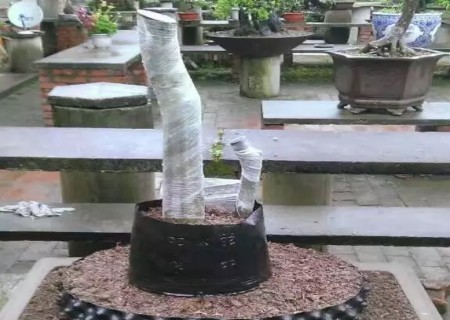
Choose as large a flower pot or container as possible; if it is not tall enough, you can raise it around the pot with plywood, thick plastic film or similar, or you can directly use a mix of 3 parts river sand and 1 part ordinary soil. Bury the stump 2/3 into the pot soil, shake the pot, firm the soil appropriately, water thoroughly, find bamboo slats or branches to build a frame, cover it with transparent plastic film to seal it, and to keep it moist you need to water frequently, or fold a thick plastic bag and put the pot inside, pour an appropriate amount of water into the bag, or use a container with water; the goal is the same, to keep it moist as much as possible.
This plant has extremely strong vitality, but if the method is not appropriate, the survival rate will be low; if the method is appropriate, the survival rate will be high. If you are enthusiastic when buying it but lazy when planting it, problems will arise!
For the soil used to grow Chinese persimmon, it is best to use semi-fertile soil, that is, plain soil, or honeycomb coal cinder plus one third humus soil, or directly potting in decomposed sawdust gives even better results. It is recommended to choose soft soil mixed with sand for better results.
When planting, the soil and the Chinese persimmon should be pressed firmly with a little force, though of course not too forcefully. All parts not wrapped in film should be buried in the soil; the film cannot be removed, and should stay on the whole time; later when buds emerge you can pierce the film at the bud sites. After sprouting you can tear open the plastic film, and you must remove the excess buds to keep the stump growing healthily; depending on the condition of the stump, keep 2-3 well-growing branches for care.
The surface of the pot can be covered with something to retain moisture, but you should not go weeks without checking it or watering it, that will not do! After watering thoroughly with a lot of water, you need to keep it moist; of course this is a plant, so it cannot sit in water either. Observe it often, do not let it dry out, and do not water frequently before buds emerge. If after planting you can cover it with a large plastic bag, the humidity inside the bag will be high, and this will greatly increase the survival rate.
Do not expose it to the sun, this is the most critical point. Do not fertilize; something without roots cannot take it. Once it has grown well later, you can expose it to the sun as you like, and then fertilizing will be no problem.
For the care of small established stumps, place them in a cool place when they arrive, do not tear off the film for the time being, and only tear open the first layer when growth begins; when the branches and leaves are lush, tear it all off, and let it transition slowly so it can adapt well to the new environment.
Shade buds love cleanliness, so wash them often, and never let them get dirty. As long as you avoid harsh sun exposure, ensure air humidity, and prevent any one branch from growing leggy, and manage to spread the nutrients to every branch tip so that the nutrients in each branch are almost even, branch loss will not occur.
But to grow it vigorously and restore its strength with a transition, and to develop a strong root system, you need to let leggy branches grow freely to achieve the goal. This is dialectically unified and mutually reinforcing; handle it flexibly and you will get twice the result with half the effort.