What are the cultivation methods for potted dragon bone cactus?
Dragon bone cactus is a climbing shrub with sword-like stems, huge flowers and fireball-like fruits. Its stems are emerald green, its flowers are large and white, and its fruits are red as fire. It is widely planted in tropical regions, so when planted in the ground at the corners and edges of exhibition greenhouses, it can display a tropical rainforest scene. The highlight of tropical rainforest charm is the varied forms, brilliant colors and a scene of verdant green, and dragon bone cactus happens to have emerald green stems and large, imposing flowers. Moreover, dragon bone cactus belongs to the Cactaceae family, giving the feeling that it grows in tropical desert areas, so it fully displays tropical rainforest charm.
In addition, dragon bone cactus is also suitable for European pastoral style. Although European pastoral style mostly involves placing abundant flowers and plants in front of doors and outside windows, in order to create a more authentic atmosphere, a pot of green vine plants is often placed at the top corner of a cabinet. Dragon bone cactus can also be planted on a balcony to show enthusiasm. When dragon bone cactus flowers bloom, it is like a large curtain of flowers falling from the sky, making the setting appear warm and full of vitality.
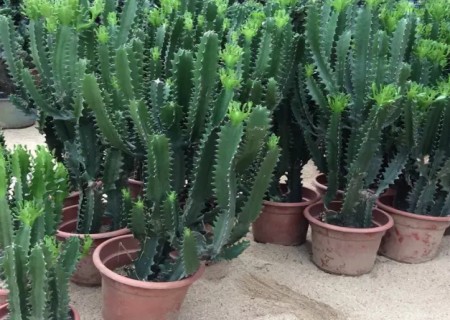
Generally speaking, the matching of home styles, especially the embellishment of plants, is indispensable. Otherwise, without these lively plants as embellishment, it is difficult to make the family atmosphere lively, as if a natural landscape is missing, and it gives people a more lifeless feeling. So, how do you grow potted dragon bone cactus? The following introduces the cultivation methods of dragon bone cactus for all plant lovers:
1. Soil
Dragon bone cactus is extremely easy to survive and likes loose, fertile, sandy soil rich in humus. For potting soil, a culture soil made by mixing 1 part leaf mold and 1 part coarse sand and adding a small amount of decomposed chicken manure or cow manure can be used. If it is difficult to find this kind of sandy soil, you can casually find some relatively soft soil. Dragon bone cactus does not have high soil requirements, and ordinary soil can keep it alive.
2. Light
It is suitable for growing under semi-shaded conditions. Although it is sun-tolerant, in order to avoid yellowing under strong light, shading measures should be taken in summer. In winter, place it in a place with light to receive a certain amount of sunlight. Indoor plants are best placed on balconies, windowsills and other places where light can be seen.
3. Temperature
Dragon bone cactus likes a warm environment, is not cold-tolerant, and fears frost. In winter, the temperature should be above 10°C for it to overwinter smoothly, and it should be given an appropriate amount of even light. It must not be lower than 7°C, so as to avoid frost damage.
4. Watering
In spring, watering should not be too much. Watering once every 10-15 days is enough, but water should be sprayed on the plant every day to increase air humidity. In summer, water once a day, preferably in the morning or evening. In winter, the potting soil should be kept moderately dry. Dragon bone cactus is drought-tolerant, so watering should be moderate. In summer, watering once every five days is enough. If the potting soil is too wet for a long time, it will cause root rot. During the winter dormant period, watering once every 1-2 months will not cause it to dry out and die.
5. Fertilizing
During the growing period, dragon bone cactus can be given a light fertilizer once every 15-20 days. It is best to use homemade fertilizer. Crush soybeans or peanuts and bury them in the flowerpot, or soak soybeans or peanuts until soft and then bury them in the soil as fertilizer. Granular compound light fertilizer or homemade alum fertilizer water can promote plant growth. The main thing is not to apply fertilizer that is too concentrated, as it easily causes fertilizer damage and root rot problems.
6. Pruning
When a newly cultivated plant grows to 10-15cm, the tip can be removed. For new branches, only retain the 3 better-growing branches at the top of each corner. When the plant grows to 20-25cm, remove the top again. After that, for each branching, remove the top at 10 centimeters longer than the length retained in the previous pruning. Note that the direction of retained branches should be determined according to the viewing angle. Dragon bone cactus pruned in this way has a full plant shape and is highly ornamental.
In addition, in order to prevent dragon bone cactus plants from aging too early and to maintain vitality at the base, attention should also be paid to frequent pruning. Cut off some old branches that do not bloom much, and also remove the weak buds growing below, so that the terminal buds develop fully and extend, resulting in more flowers.
7. Overwintering
A plastic film can be used to wrap the pot for protection during overwintering. The overwintering cultivation environment should maintain both a relatively high temperature and relatively high air humidity. In winter, sufficient light is required, and it should be placed in a sunny indoor spot. The temperature should be kept above 10°C, and the pot should be turned at certain intervals. In the north, dragon bone cactus cannot be grown indoors, as it is prone to frost injury and freezing death.
8. Pests
Dragon bone cactus has relatively few pests. Poor indoor ventilation makes it prone to red spider mite damage at the top. If the top of the branch is found to be reddish-brown and has webbing, it can be sprayed with 1000x to 2000x omethoate. The dosage must not be too large, to prevent the top from rotting.