How to care for potted Aptenia cordifolia? A detailed guide to growing methods
Aptenia cordifolia is a perennial evergreen trailing succulent herbaceous plant. Its stems and vines are fairly soft, the branches droop, its leaves are thick and fleshy, and the foliage is emerald green. In spring, rose-red flowers bloom from the tips of the branches, looking especially lovely against the green leaves. The flowering period can last into autumn. It is one of the finest potted flowers for decorating living rooms and windowsills.
Many people call Aptenia cordifolia "Tianqi" or "Chuanxinlian", but those are just names made up by some vendors to fool people. I still prefer to call it Aptenia cordifolia. Its leaves are tender and delicate, and it can grow hanging, so it is also great to keep as a trailing plant. With proper care it also produces small pink flowers that people love.
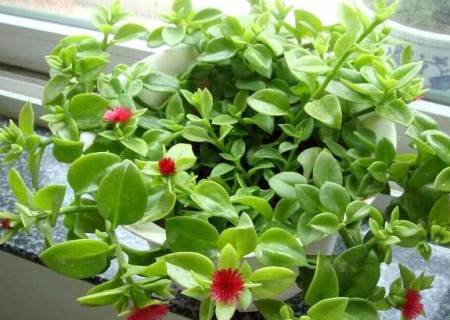
Aptenia cordifolia is mostly used for potted display, and can also be used as an accent when planting other flowers and plants. It is suitable for garden arrangements and desert landscapes. So, how do you care for Aptenia cordifolia? Below is an introduction to the growing methods for potted Aptenia cordifolia.
1. Soil
Aptenia cordifolia is native to South Africa. It prefers a sunny, dry and well-ventilated growing environment, dislikes high temperatures and excessive moisture, and likes well-drained sandy soil. It is fairly easy to care for. Aptenia cordifolia likes loose humus soil. Choose a mix of leaf mold, garden soil and river sand, or simply use peat soil combined with perlite. Its roots are fleshy, so drainage must be guaranteed.
2. Light
Aptenia cordifolia is a plant that quite likes sunlight. If you want more flowers, you must give it plenty of light, at least more than 6 hours of light per day. It is best kept on a south-facing or west-facing windowsill. In winter it can get light through the window. Throughout the year, apart from appropriate shading at midday in the height of summer, it should be given sufficient light at all other times, especially in winter. While ensuring the temperature, it can be placed in a sunny spot to receive as much sunlight as possible. If it is placed in a place with insufficient light for a long time, the leaf color easily becomes pale, it lacks vitality, and the leaves may even drop, losing its ornamental value. If conditions allow, you can place it outdoors starting in spring. A plant that has received sufficient light will have abundant flowers and brilliant colors, and its leaves will also be less prone to becoming leggy.
3. Temperature
Aptenia cordifolia likes a warm and comfortable living environment and dislikes high temperatures and cold. Its optimum growing temperature is 15-25°C. In summer, when the temperature is too high, pay attention to cooling the plant. It can be moved to a well-ventilated, semi-shaded spot for care. It is not cold-tolerant, so care is needed once autumn arrives. When the weather turns cool, attention should be paid to keeping it warm. Those placed outdoors should be moved indoors in time to avoid the cold, so as not to freeze the plant.
4. Watering
Aptenia cordifolia likes a dry environment, so it should not be watered too much. The water and fertilizer management can be adjusted according to the specific growth conditions of the Aptenia cordifolia. Of course, watering should be appropriately reduced in winter. After it turns cool in autumn, begin reducing the watering frequency and keep the soil slightly dry. If your Aptenia cordifolia has especially lush leaves but no flowers instead, then you should appropriately control water and let the potting soil dry out a bit, so that flower buds can form. Especially in the high-temperature period of summer, while increasing the amount of watering, also note that there must be no standing water in the pot. Follow the principle of "water when dry, water thoroughly", and water thoroughly only after the potting soil has dried. Too much water easily causes root rot, and in severe cases can lead to death. After September, Aptenia cordifolia enters a period of slow growth. At this time, gradually reduce the amount of watering to prepare for moving it indoors to overwinter.
5. Fertilizing
Aptenia cordifolia likes light fertilizer. Applying light fertilizer frequently can make the plant more robust. Combined with appropriate pinching of the tips, it can grow lush branches and leaves, which is more conducive to forming flower buds. Aptenia cordifolia does not have high requirements for fertilizer and water. During the growing season, applying cake fertilizer water about once every half month is enough. This can be adjusted according to the specific growth conditions of the Aptenia cordifolia. Generally, fertilize more in spring and autumn and do not fertilize in winter. In spring and autumn, you can give light fertilizer twice a month. Ordinary compound fertilizer or decomposed cake fertilizer is fine. If you want it to bloom more easily, you can water it once a month with monopotassium phosphate, which can promote the formation of more flower buds.
6. Pruning
When winter arrives, the leaves of Aptenia cordifolia stop growing and it enters the dormant period. Diseased and pest-damaged branches, overlapping branches, twin branches, thin and weak branches, aged branches, inward-growing branches and leggy branches must be cut off in time. Through thinning, heading back and removing suckers, the lifespan of the peony can be extended. Keep the peony well-ventilated and well-lit, so it is less prone to pests and diseases, ensuring the tree remains vigorous with thick branches and lush leaves.
7. Repotting
Potted Aptenia cordifolia is generally repotted once every 1-2 years. When repotting, you can appropriately trim off the old dead roots. After potting, first care for it in a shaded place for two weeks, then gradually expose it to light.
8. Pests
Aptenia cordifolia grows extensively and is not prone to pests and diseases. However, if the potting soil is waterlogged and ventilation is poor, besides causing root rot, root rot disease may also occur, so attention should be paid to spraying medicine for prevention and control.
9. Overwintering
For winter care, of course, attention must be paid to cold protection, and the watering frequency should be reduced. Some crossing branches can be cut off and used for cuttings propagation as well. Note to maintain a certain indoor air humidity and keep the temperature above 5°C. Appropriate pruning can be carried out, cutting off some overly long or overly dense branches to conserve nutrients, so that more flowers can bloom next year.
Aptenia cordifolia is not cold-tolerant, so care is needed once autumn arrives. When the weather turns cool, attention should be paid to keeping it warm. Those placed outdoors should be moved indoors in time to avoid the cold, so as not to freeze the plant.
Precautions
1. If Aptenia cordifolia is placed in a place with insufficient light for a long time, the leaf color easily becomes pale, it lacks vitality, and the leaves may even drop, losing its ornamental value.
2. Watering Aptenia cordifolia too much will cause root rot, and in severe cases can lead to death, so the amount of watering must be controlled well.
3. Aptenia cordifolia does not have high requirements for fertilizer or water. During the growing season, note to apply cake fertilizer water once about every half month. If too little fertilizer is applied, it will cause slow growth.