An introduction to Persian buttercup cultivation methods, teaching you how to grow it
Persian buttercup, also known as Ranunculus asiaticus, buttercup, celery flower, and Persian crowfoot, is a plant of the genus Ranunculus in the family Ranunculaceae. Its layer upon layer of petals gather softly and neatly together, making people want to hold it in their hands. The flower language of Ranunculus asiaticus means charming allure, making it very suitable whether for a few stems in a vase at home or a whole bouquet arranged at a banquet.
The leaves of Persian buttercup resemble celery leaves, so when the flowers first arrive, the buds are only about the size of a button, the flower heads are bent, listless, and there are many leaves. It looks unremarkable, just like buying a bunch of vegetables that does not even look appetizing, but its characteristic is thin petals and many petals, so its explosive power is extremely strong. The buds on arrival may be only about 2 cm, and after a few days of care the flower diameter can reach 5 cm or even 10 cm, with the flower heads standing upright and full of energy. The more you cut, the bigger they open, and the layered combination of petals is stunning.
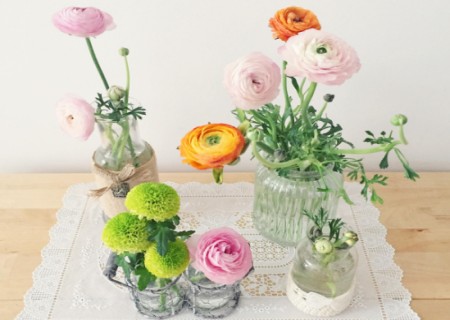
So, how should potted Persian buttercup be cared for? After receiving it, cut a small section diagonally at 45° at the lower end of the flower stem, adjust the length according to the height of the vase, fill the vase with more than half water, and if there is preservative, put in half a packet. Replace the water about every 3 days and wash the roots and cut diagonally again. If there is no preservative, change the water, wash the roots, and cut diagonally every day. When changing the water, be careful to keep the vase clean, and if necessary use 84 disinfectant to clean it. Avoid direct sunlight. The specific cultivation methods are as follows:
1. Take a clean vase;
2. Pour the care solution into the vase, add clean water in proportion, and wait until it is fully dissolved. The water level for Ranunculus asiaticus is generally 10-15 cm.
3. Remove leaves in poor growing condition. Ranunculus asiaticus has hollow stems, so cut the roots diagonally at 45°. The scissors must be clean and sharp.
4. Do not spray water directly on the flowers, to avoid mildew and rot;
5. Change the water once every two days to keep the water clean;
6. Ranunculus asiaticus is cold-tolerant but not heat-tolerant. Never place it in an air-conditioned room, otherwise before the flowers even open, the stems near the flower heads may already rot and break.
Notes:
1. Persian buttercup likes moisture, fears waterlogging, and is afraid of drought. During the growing period it must not lack water, but it should not be too wet either. At the same time, avoid pouring water on the leaf surface, otherwise it will cause disease.
2. Persian buttercup likes a sunny environment and a cool climate, but the temperature must not be lower than 10°C, nor higher than 25°C.
3. Persian buttercup likes fertilizer. Pay attention to topdressing during the growing period. At the beginning, apply a light fertilizer once every 10 days. Later, as the seedlings grow, gradually increase the amount and concentration.
4. Persian buttercup avoids direct strong light. Potted plants should be placed in a lightly shaded, fresh environment, protected from drought, waterlogging, and dust pollution, and the potting soil and surrounding environment should often be kept moist.
5. If the potting soil has a high organic matter content, only apply 1 to 2 times a thin liquid fertilizer mainly based on phosphorus and potassium fertilizer before and after budding.
6. After flowering, cut off the spent flowers at any time, then apply liquid fertilizer 1 to 2 times to nourish the roots, and control water appropriately so it can safely enter summer dormancy.
7. If planting Persian buttercup in a courtyard, the plant and row spacing is 15 cm to 20 cm. For potted planting, one bulb for a small pot, and two bulbs for a large pot. In warm areas it can overwinter outdoors, but in cold regions it needs to overwinter indoors.
8. The potting soil should be kept in a semi-dry state to prevent the bulbs from rotting.
9. In spring it should often be kept moist, but during the flowering period the soil should be slightly dry, and liquid fertilizer should be applied 1 to 2 times. After the bulbs are harvested in summer, they should be fully dried and placed in a ventilated and dry place, otherwise they will rot extremely easily.