What are the cultivation methods for potted Ardisia crenata (coralberry)?
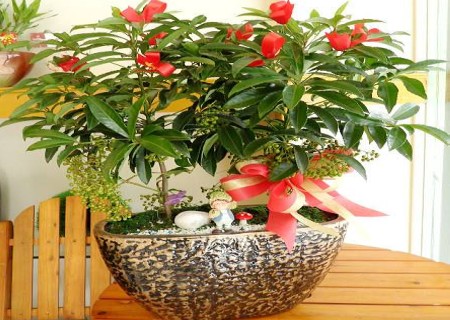
"Ardisia crenata" is locally known in southern Fujian as "mountain longan" and is a newly developed flowering plant that is easy to grow and whose fruit is edible. Also known as "wealth fruit," after autumn its red berries can remain on the branches for as long as 16 months, so many people like to buy potted plants at New Year's Day and in spring to place on windowsills and desks, which can add a rich and festive atmosphere to the holiday and bring both wealth and good fortune in the new year.
Ardisia crenata is also what we commonly call coralberry. It happens to be on the market at Spring Festival, symbolizes festivity and good fortune, and is often the top choice of flower for celebrating weddings, business openings and housewarmings. It is an excellent fruit-bearing ornamental plant suitable for indoor potted display. But how do you cultivate and care for a potted Ardisia crenata at home?
1. Propagation time
For Ardisia crenata, late May to mid-June or late August to early September is the best time for cuttings. This is because the temperature at this time is around 25°C to 30°C, which is most suitable for plant growth.
2. Soil preparation
Ardisia crenata prefers a cool, moist, neutral sandy soil. You can use purchased nutrient soil or mix your own. Mixing method: use 70% to 80% fairly fertile soil (pond mud, humus soil, old garden soil, field soil), 10% to 15% coarse sand, and 10% to 15% decomposed oil-free wood shavings or unburned rice-husk ash to make nutrient soil; other mixing methods may also be used. In short, the nutrient soil should be fertile, loose and well-draining.
3. Humidity requirements
Ardisia crenata likes a shady, humid environment. In spring it should be placed on a windowsill that receives morning and evening light, keeping the potting soil moist. You should often spray water around it and on its leaves several times to increase air humidity, and pay attention to indoor ventilation. The relative air humidity of the growing environment should be 50-70%.
4. Temperature requirements
In winter, the temperature for Ardisia crenata should be controlled between 18-24°C. In winter, when the fruit turns red, watering should be reduced, and a wintering temperature no lower than 5°C is sufficient.
5. Light requirements
Ardisia crenata is a semi-shade plant and likes a semi-shaded, well-ventilated, short-day growing environment. You should create a good environment for it. You can build a shade shed: use a plastic greenhouse, or make a shade shed with shade netting, requiring a shading rate of 60% to 90%. In short, as long as it can block sunlight, lower the temperature and increase humidity, it is fine.
6. Key watering points
Ardisia crenata needs to be watered according to the different seasons, weather changes, the size of the pot, how good the pot's drainage is, and the different placement locations. In spring, generally water once every 3 to 4 days; in summer, 1 to 2 times a day; in autumn, once every 2 to 3 days. As for watering time, since temperatures are high in summer and autumn, water in the morning and evening; in winter, it is best to water at noon. In short, pay attention to watering at the right time and in the right amount, keeping the potting soil moist, neither dry nor waterlogged.
7. Applying fertilizer
Ardisia crenata should be fertilized according to the size of the seedling, the different seasons, and whether the plants are fruit-bearing or non-fruit-bearing branches. In summer and autumn, growth is relatively vigorous and nutrient needs are high, so more fertilizer can be applied; in winter and early spring, the plant is basically dormant, so little or no fertilizer can be applied. In short, you must both meet the needs of the seedling's growth and development and prevent the plant from growing excessively, which would affect its ornamental value. Therefore, the best approach is: apply less concentrated fertilizer, apply more dilute fertilizer, and apply more phosphorus and potassium fertilizer. Start topdressing after new leaves sprout. When the outdoor temperature is stable above 15°C, it can be moved to a semi-shaded balcony or courtyard for cultivation. After the temperature rises in late spring, growth accelerates, so pay attention to replenishing water and fertilizer.
8. Key pruning points
When the new shoots of Ardisia crenata grow to more than 8 cm long, remove the tips and pinch them back to promote branching.
9. Repotting and soil changing
As long as Ardisia crenata is cared for properly, it will grow very quickly. When it grows to a certain size, you should consider giving it a larger pot so it can continue to grow vigorously. For repotting, the culture soil and component ratios can be chosen from one of the following: garden soil: cinder = 3:1; or garden soil: medium-coarse river sand: sawdust (mushroom residue) = 4:1:2; or one of paddy soil, pond mud, or leaf mold.
10. Pest and disease control
Leaf spot disease caused by fungal and other pathogenic infections in Ardisia crenata easily causes localized necrosis of the leaves, with yellow spots or patches appearing; in severe cases, the entire leaf turns yellow and falls off. After infection by mosaic virus, yellow-green mottled patches appear on the leaves; when damaged by scale insects, red spider mites and the like, the leaves also become locally yellow and withered, or even the whole leaf wilts, yellows and falls off. In all cases, pesticides should be sprayed promptly for control.
The care requirements for Ardisia crenata during the flowering and fruiting stages are relatively high. The main thing is to pay attention to water and fertilizer supply; during the fruit-viewing period, water and fertilizer requirements are not high, and as long as it is not exposed to freezing, it can be placed for a long time in a room with soft light, and the viewing period can last until the spring of the following year. The following are the four-season care and management methods for Ardisia crenata:
1. Spring
Ardisia crenata should be repotted once a year between April and May, and it should be properly pruned before repotting.
2. Summer
Ardisia crenata tolerates high temperatures but not direct sunlight. In summer it should be placed on a bright balcony or indoors. Indoors it can be displayed and grown as a foliage plant.
In summer, Ardisia crenata is in its peak season of growth and flowering, so attention should be paid to the supply of water and fertilizer. When placed indoors, spray water around it and on its leaves frequently, and strengthen ventilation. After flowering, pay attention to changes in fertilizer application.
3. Autumn
In autumn it should be placed in a semi-shaded outdoor area or a bright indoor area for cultivation, keeping the potting soil moist. For potted plants placed indoors, spray water around them and on their leaves frequently to increase air humidity, and stop fertilizing.
After the temperature drops in late autumn, gradually reduce the water supply and water alternately dry and wet. Move potted plants placed outdoors into a lighted indoor area or an enclosed balcony with a temperature of about 5°C before frost.
4. Winter
Ardisia crenata fears severe cold in winter and can only overwinter safely when the temperature is above 5°C. Winter is exactly the fruit-viewing period, so it can be placed on a windowsill with morning and evening light or in a bright indoor area, watered alternately dry and wet to keep the potting soil moist, and when the temperature is relatively high at noon, spray water around it and on its leaves several times. The indoor temperature should not be too high; 5-10°C is sufficient. Indoors, there should be proper ventilation.