How to grow a Syzygium buxifolium bonsai? Detailed care guide
Syzygium buxifolium is highly ornamental and also suitable for training as a shaped tree; it is an excellent garden plant and can be used as a hedge or bonsai tree. Syzygium buxifolium likes high temperatures, high humidity and sunny locations; when caring for it, placing it in full sun is better, though it can also be placed in partial sun. If kept for a long time in a shady, damp place, it will have few fibrous roots, grow weakly and struggle to overwinter.
Now let's take a look at how to grow Syzygium buxifolium! The care of Syzygium buxifolium can follow these practices:
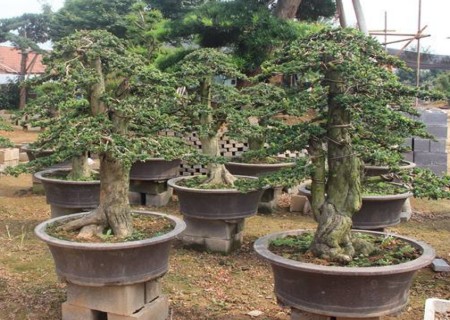
1. From April to June, Syzygium buxifolium should be placed in a spot with plenty of sunshine and rain, and the potting soil should always be kept moist. It must not lack water at ordinary times; once it lacks water, branches will be lost, and in severe cases the whole trunk will die.
2. Use loose potting soil or medium, and keep the pH of the potting soil at 5—6.
3. Pay attention to maintaining humidity. The practice commonly seen in some materials that potted plants should be watered "when dry, then wet" is not suitable for the care of Syzygium buxifolium.
4. Syzygium buxifolium can be repotted and have its soil changed once every 3 to 4 years, preferably in early April. After changing the soil, water thoroughly, place it in a shady spot and keep it moist; after new shoots emerge, gradually move it to a place with plenty of sunshine and rain to encourage vigorous growth.
5. Follow the principle of "don't water until dry, and water thoroughly when you do." New stumps should be kept moist and must not lack water. Established Syzygium buxifolium plants should not be too dry in autumn, to prevent heavy leaf drop. In winter, ensure sufficient moisture before the cold wave arrives; they must not dry-freeze.
6. Syzygium buxifolium likes fertilizer, but concentrated fertilizer must not be applied; too high a concentration can cause root rot. New stumps do not need fertilizing in the first year. From the second year on, depending on the plant's growth, apply organic fertilizer once every half month or once a month during the growing season. If it bears fruit, increase the fertilizing frequency. Apply light fertilizer frequently, mainly nitrogen and potassium fertilizer, mixed with trace elements and watered on; older trees can be given more foliar fertilizer sprays.
7. Potted plants should not be allowed to bloom and bear fruit. Blooming and fruiting not only consume extra nutrients but also easily cause branches to age, and in severe cases can cause the whole plant to decline. Avoiding flowering can be tackled from two aspects: controlling fertilization and adjusting the pruning method.
8. Build up branches in moderation; branches should not be left too long. There is a method to pruning: it is better to use the thinning-and-building method, cutting shoots and keeping branches. The trunk-cutting-and-building method should not be used; if it is used, the thickness of the built-up branches should not exceed 1 cm, and after cutting the trunk there should preferably be branches or leaves on the inner side. Cut trunk ends must be sealed, and plenty of water should be sprayed on the leaves. Bundling and tying should not be used. If tying is absolutely necessary, the wire must be removed early, otherwise branch shrinkage is likely. Heavy pruning should be done from January to May, and pruning in August and September should be avoided as much as possible.
9. Syzygium buxifolium bonsai is prone in autumn to white slime mold harming the small branches. You can scrape off the white slime mold with a bamboo strip and let the bonsai get more sun; this generally controls it.
Syzygium buxifolium is a mainstream variety among bonsai enthusiasts. As long as you choose a good, healthy stump and care for it properly, a Syzygium buxifolium bonsai can certainly thrive indefinitely and be incomparably beautiful. May bonsai colleagues work together to make Syzygium buxifolium another highlight of the bonsai industry!
Solutions for yellowing leaves on Syzygium buxifolium:
First, pour out the sand in the pot and refill it with organic fertilizer as the medium; organic fertilizer made by mixing decomposed plant straw and animal manure with sand is best.
Second, buy compound fertilizer to make a liquid feed; mix compound fertilizer with water at 1:10 and water it on three times.
Syzygium buxifolium mostly grows in clumps, and its root masses are endlessly varied, so it can be shaped as a stump using roots in place of a trunk. After digging up the stump, cut off damaged roots and saw the bottom in one go according to bonsai requirements. Old stumps have unusual forms, strong vitality and long lives; even if the trunk is hollow and full of holes, they still grow lush branches and leaves.