How to grow potted jasmine? Detailed guide to cultivation methods and precautions
The evergreen small-shrub type of jasmine has emerald-green leaves, pure white flowers and a rich fragrance, and is a common fragrant ornamental flower for gardens and pots; it is mostly grown in pots to adorn interiors, elegant and pleasant, and can also be made into garlands and other decorations; while the deciduous vine type, mostly yellow and fragrant white flowers, is one of the best ways for many households abroad to adorn their winter gardens.
"When flowers bloom all over the garden, none is as fragrant as it" - it is the jasmine, whose "single bloom can scent a whole room." Though jasmine has no dazzling beauty to astonish the crowd, it combines the sweetness of the rose, the fragrance of the plum blossom, the subtlety of the orchid and the elegance of the magnolia. Right now is the jasmine blooming season; besides its ornamental value of pure white color, its fresh scent, for many people with poor sleep, means that placing a blooming jasmine in the bedroom can also calm the nerves and help improve sleep.
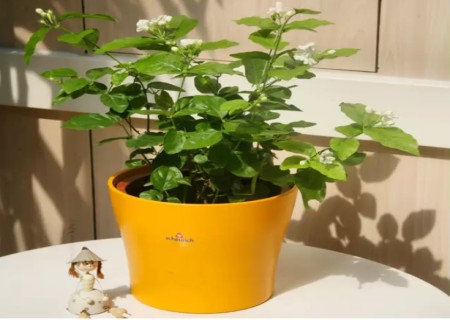
Potted jasmine is easy to grow in spring, summer and autumn; the difficult season for care is winter. The cultivation method for potted jasmine can be summed up in an eight-character formula: plenty of water, plenty of fertilizer, high temperature and full sun, as follows:
1. Plenty of water: jasmine has shallow roots and well-developed fibrous roots, with dense branches and leaves; in summer the temperature is high and evaporation is great, and since it is itself not drought-tolerant, the soil must not be too dry, but it should not be muddy either. Clay pots are best; plastic and porcelain pots have poor air permeability and can be used as outer pots. The prerequisite for plenty of water is good soil aggregate structure, loose and airy. The principle of heavy watering is alternating dry and wet, watering thoroughly once the soil has dried out. Note that drying out definitely does not mean scorched dry.
2. Plenty of fertilizer: jasmine has a long growth cycle, a large annual growth volume, and repeatedly sends out shoots and blooms, so nutrients are consumed quickly and energy demand is high; if fertilizer cannot keep up, it will grow thin and weak, with fine branches, thin leaves and few flowers. The prerequisite for plenty of fertilizer is mainly decomposed organic fertilizer, which is extremely important, such as rapeseed cake water (top dressing) and poultry and fish offal water (top dressing), supplemented by chemical fertilizers such as potassium dihydrogen phosphate. The fertilizing method is to apply on sunny evenings during the growing season, then water back the next morning (crucial), once a week during the growing season.
3. High temperature and full sun: jasmine loves sunlight extremely and must never be overly shaded; full sun is best provided water is guaranteed. With ample sunlight the branches are luxuriant and flowers numerous; with low temperature and shading the leaves are thin, flowers sparse and branches fine. In addition, before spring sprouting and after each batch of flowers, moderate pruning can ensure the branches are properly spaced, nutrients are concentrated, and ineffective consumption is reduced.
In addition, there is the issue of building vigor during care. After jasmine has grown for five years, the main branches age, the upper branches become thin and weak, and the flowers tend to be smaller. During this period, special attention should be paid to cultivating more basal soil-grown shoots; such shoots grow robustly, and if properly guided to the old main branches that need renewing, after a year of growth they can replace the old branches. Cut the old branches off flush with the soil surface, achieving the goal of renewing the main branches, strengthening the tree vigor and maintaining vitality.
Now that the household cultivation and fertilizing methods for jasmine have been introduced, follow Uncle Gardener to look at other care points and precautions for household potted jasmine!
1. Soil: jasmine should be grown in fertile sandy or semi-sandy soil. Planting in slightly acidic soil with a pH of 6.0-6.5 allows dense roots and robust growth; while heavy clay soil with low fertility results in few roots, a short plant, slender stems and leaves, and few small flowers.
2. Light: jasmine likes hot, humid, ventilated environments; it is a long-day, sun-loving plant and needs ample light, preferably more than 5 hours of light per day. Jasmine is sensitive to cold; in Central China, South China and other places jasmine can be grown outdoors through the winter, while in the north, warmth protection is needed in autumn, and when moved indoors it should be placed in the sunniest spot facing south. Strong light makes the branches robust, the leaves dark green, and the flowers numerous, well colored and strongly fragrant. Therefore, for jasmine to bloom abundantly, the environment must be good and the light ample.
3. Watering: jasmine is not drought-tolerant but also dislikes waterlogging; in the rainy season, promptly drain accumulated water from pots or planting sites, otherwise the leaves easily turn yellow, commonly called water yellowing. On hot sunny summer days, water twice a day, once in the morning and once in the evening; if leaves are found curling and drooping, spray water on the leaves.
4. Fertilizing: jasmine loves fertilizer; the high-temperature period of midsummer is the vigorous growth period of jasmine, requiring heavy fertilizing, with more organic fertilizer and phosphorus-potassium fertilizer, such as decomposed sesame paste residue, superphosphate, compound fertilizer and multi-element flower fertilizer, applied twice a week. At home, liquid fertilizer can be made by fermenting kitchen scraps with black alum. Fertilizing should follow the principle of light fertilizer applied frequently. Note not to fertilize when the potting soil is too dry or too wet; fertilizing when the potting soil is neither quite dry nor quite wet works best.
5. Pruning: jasmine grows very fast in summer and should be pruned in time; after pruning potted jasmine, keep 10-15 cm at the base to promote thick new shoots. If the new branches grow very vigorously, pinch out the tips when they reach 10 cm, promoting secondary shoots so there are more flowers and the plant shape is compact. After the flowers fade, the flowering branches should be cut off to reduce nutrient consumption.
6. Pest and disease control: jasmine often suffers from scale insects and red spider mites, which frequently attack the flower buds, most seriously from July to September. Spray 50% phoxim emulsifiable concentrate at 1000 times dilution, once every half month, for 2-3 consecutive sprays.
Precautions:
Do not spray water on the flowers during the jasmine blooming period, to prevent early flower drop and loss of fragrance; during heavy rain, shelter the jasmine or move it indoors. Repot every 3 years, preferably in late winter or early spring. No need to trim the roots; replace with new nutrient soil, and place some bone meal and horse hoof slices at the bottom of the pot as base fertilizer, then water thoroughly. If jasmine only grows branches without blooming, this is caused by too much nitrogen fertilizer and insufficient sunlight; if you apply more phosphorus and potassium fertilizer and move it to a sunny, well-ventilated spot, it is generally not difficult for it to form buds and bloom.