How to add roots to a maple bonsai? Full process illustrated step-by-step guide
The roots of a plant are the main source of artistic beauty in stump bonsai. One-sided roots (roots of a potted plant developing toward one side) when the plant is young will become more obvious as time goes on, and during cultivation the exposed roots will inevitably be damaged for various reasons, until the ornamental effect of the bonsai is affected. These defects are generally difficult to correct by pruning, wiring and other techniques. The root grafting method introduced here (called "ya gen" by people in Guangzhou) is to use artificial root supplementation to prompt the root area of the stump that needs improvement to "grow" roots.
Collected stumps are generally older and have larger roots. Because of natural growth, the branches and trunk have beautiful posture, but the roots often have shortcomings. During the cultivation stage, the root supplementation method can be used to induce new roots. If one side of the stump has no roots, the approach grafting method can be used, selecting seedlings of the same species and planting them close against the root. In the second year, the stump and the grafted seedlings are cut. This root supplementation method can restore vitality to the incomplete root system of an old stump and promote renewed growth. By using the stump's root-accumulation method, an ideal root form can be created.
This maple was grown from a cutting; after rooting it was grown in the ground for 5 years, and both its thickness and root system are very robust.
The full view before the maple was transplanted into a pot.
At the position lacking roots, drill directly and thread a small seedling through.
One year later, the small seedling inserted through the hole is growing healthily and has basically merged with the large tree into one.
In the second year, for the small seedling that has already grown densely at the drilled part, cut off the branch above. For places that do not fit tightly, apply growth healing agent so the scion can grow more healthily.
After 5 years, the branch inserted through the hole has become very thick, and there is no need to keep the branch above it.
Apply wound healing agent to the cut end of the branch after cutting to accelerate wound healing.
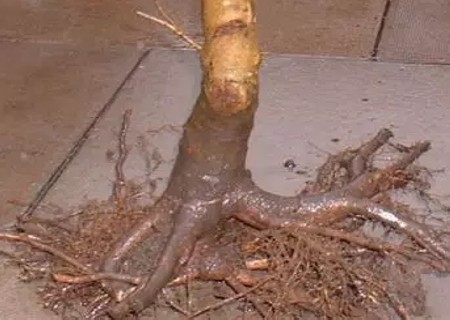
Before repotting, the washed root system is very well developed, with roots spreading in all directions, strong and powerful.
In order to make it easier to plant in a shallow pot and make the bottom flatter, carve the bottom of the tree roots.
A close-up of the thick roots; the original roots and the grafted supplementary roots can be clearly distinguished.
A close-up of the root supplementation position.
The effect after potting. The height is 30 cm, and the trunk diameter exceeds 8.5 cm
After 9 years, with the support of the well-developed root system, the maple grows rapidly.
After so many years of cultivation, the drilled joint position can basically no longer be seen.
The appearance of the maple after 14 years of cultivation. Height 35 cm, trunk diameter 7.5 cm.