Management Methods and Technical Key Points After Grafting Pear Trees
Grafting is the artificial joining of tissues such as a branch or bud from one plant onto a suitable part such as a branch, trunk or root of another plant, so that they heal and grow together to form a new plant. This branch or bud is called the “scion”, and the plant that bears the scion is called the “rootstock”. Grafting is indicated by the symbol “+”, that is, rootstock + scion; it can also be indicated by “/”, but its meaning is the opposite of that indicated by “+”, and generally the scion is placed before the “/”. For example, if Huangjin is grafted onto shanli, it can be expressed as “Huangjin/shanli”, or “shanli + Huangjin”.
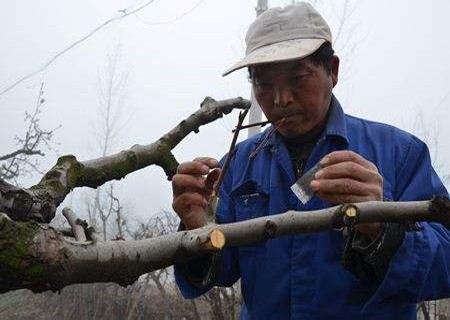
So, how should pear trees be managed after grafting? The following explains the technical key points for management after grafting pear trees:
1. Timely re-tying: Check at any time within half a month after grafting. Film broken by birds or grafted buds that are not tightly tied should be re-tied in time to prevent the grafted buds from losing water and dying.
2. Assisting film breakage: By early May, most grafted buds from the cut-side graft method will have broken through the film and grown out. At this time, if a few cannot break through the film and sprout branches, use a toothpick to pierce the film so the grafted buds can grow out. Note that the film should not be broken too early, to prevent the grafted buds from dying due to exposure to air.
3. Bud removal: While the grafted buds sprout, latent buds on the rootstock tree also sprout in large numbers. At this time, sprouts near the successfully grafted part should be removed as early as possible; for sprouts near the part that did not graft successfully, one should be retained and all the rest removed, and supplementary grafting should be carried out from June to August.
4. Tying shoots, removing film and opening the angle: When new shoots grow to 30cm, use bamboo poles to tie and secure them so they grow upright. Afterwards, as the new shoots continue to elongate, continue tying and securing them 2-3 times. In early to mid-June, remove the plastic film used to tie the grafted buds at the time of grafting. From late June to early July, when new shoots grow to 80-120cm, use bamboo poles to tie and pull the branches to open the angle, at about 50 degrees, to favor flower formation on the branches.
5. Building a trellis: High-grafting to replace superior varieties of pear trees uses an open-center tree shape and trellis-type flat-plane production cultivation technology. The height of the trellis is 2.1m, the supports use reinforced concrete poles, and the upper part uses a steel strand structure, with the best grid size being 50×50cm.
6. Spraying pesticides to prevent insects: From after grafting to the germination period, the trees are most vulnerable to damage from early-spring pests, so pesticides should be sprayed in time for control.
7. Checking survival, untying and supplementary grafting: 7-15d after grafting, check the survival situation. For bud grafting, if the grafted bud is fresh and the petiole falls off at a touch, it has survived; for branch grafting, whether it has survived can only be determined after the scion sprouts and shows a certain amount of growth. Those that have survived should have the ties removed in time, and those that have not survived should be supplementary grafted above or below them.
8. Cutting the rootstock: For bud grafting in late summer and autumn, promptly cut off the rootstock above the grafted bud before germination the following spring to promote sprouting of the grafted bud; for spring bud grafting, cut the rootstock immediately; for summer bud grafting, generally untie and cut the rootstock after 10d. When cutting the rootstock, the blade of the pruning shears should face the side of the grafted bud and cut 0.3-0.4cm above the bud piece. The cut should slant slightly toward the back side of the bud, which helps the cut heal and the grafted bud sprout and grow, but the cut must not be too low, to prevent damaging the grafted bud.
9. Removing sprouts: After cutting the rootstock, many sprouts will appear at the base of the rootstock and must be removed in time to prevent consumption of nutrients and water. Removing them too late will cause wounds on the nursery stock and affect its quality.
10. Supplementary grafting: Check in time 10d after grafting, and promptly supplementary graft those that have not survived.
11. Loosening and untying: Generally, when the new shoot grows to 30cm after grafting, it should be loosened in time, otherwise it is prone to forming constriction marks and wind breakage. If the wound has not healed, it should be tied again, and checked again after 1 month, until the wound is completely healed and then fully removed.
12. Setting up supports: At the same time as the first loosening, use wooden sticks 3cm in diameter and 80-100cm long, tie them to the rootstock, and guide and tie the new shoots to their upper ends. Each graft union should have a stick tied to it to prevent wind breakage. When using the side-graft method with a living stub retained, the new shoots can be directly guided and tied to the living stub.
13. Shaping in the nursery: For semi-finished seedlings of certain tree species and varieties, after germination during the growth period, secondary shoots, that is, second or multiple shoots, will sprout. For example, peach trees can sprout 2-4 secondary shoots in the same year. These secondary shoots can be used for shaping in the nursery to cultivate high-quality, well-formed large seedlings.
14. Pinching: Pinch at the end of August to promote maturation of new shoots and improve cold resistance.
15. Other management: For young trees that have been grafted, apply fertilizer once in mid to late May; for large trees that have been top-grafted, apply fertilizer in autumn after new shoots stop growing; for all types of grafted trees, spray pesticide (0.3% KH2PO4) 2-3 times in August-September, which helps prevent winter shoot shriveling and the formation of female flowers the following year. At the same time, do a good job of soil management and weed control.