How to grow a mountain pine bonsai? Detailed care and management methods
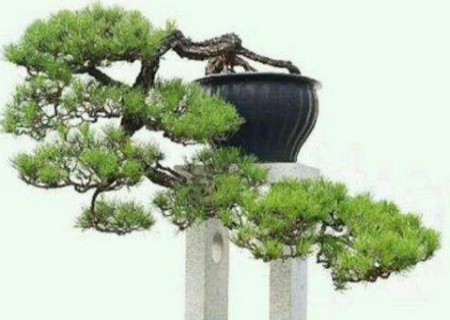
Mountain pine, also known as Masson's pine, is a common tree species. Material suitable for making bonsai is relatively scarce, and it grows slowly, making it difficult to shape and care for. However, its tree form is beautiful and can express many kinds of artistic conception, so it is quite precious.
Since bonsai is a living art, its creation has no endpoint; the process of care and management is the continuation and extension of styling. For pine bonsai, with reasonable care, the longer the time, the more perfected the styling becomes. Pine trees live very long, and pine bonsai are heirloom works, so care and management are all the more important.
Mountain pine is tolerant of poor soil, yet it also likes fertilizer. During the period of growing the stock, fertilizer should be applied lightly and frequently. In late spring, early summer and autumn, apply once a month with thoroughly decomposed cake fertilizer diluted 20 times. For those in larger pots with well-developed roots and good growth, the number of fertilizer applications can be appropriately increased. If conditions permit, thoroughly decomposed shellfish fertilizer or fish fertilizer can be applied, which is most effective for promoting vigor; use high-quality high-efficiency granular compound fertilizer with caution. Generally do not apply nitrogen fertilizers such as urea or human waste, because pine needles can absorb nitrogen from the air, and pine roots are very sensitive to nitrogen.
Do not fertilize in midsummer, severe winter or on rainy days. Applying liquid fertilizer in the afternoon when the soil is somewhat dry is most suitable; after applying, water once more to facilitate root absorption. Never apply raw fertilizer or concentrated fertilizer to mountain pine; raw fertilizer burns roots, and excessive concentrated fertilizer will cause needles to grow leggy, damage roots, and even lead to reverse sap flow, causing the plant to lose water and wither.
As the saying goes: “Dry pine, wet cypress.” Mountain pine is likewise afraid of waterlogging and standing water, and prefers somewhat dry conditions, but it is not that the drier the better. In fact, as long as the soil is loose and the bottom layer drains well, the soil should be kept consistently moist. During the high-temperature period in summer, water thoroughly once each morning and evening, avoid watering at noon, which can burn and suffocate roots, and try to avoid sun exposure at the pot edges that can burn the root hairs. In other seasons, decide according to the weather; in winter, water once every three or four days, but it must be watered thoroughly.
Mountain pine care is actually rather extensive and not as difficult as imagined. A potted mountain pine can be repotted once every three or four years. In fact, as long as the potting soil drains well, the pot size is moderate, and fertilizer and water are appropriate, it will still send out new shoots every year and grow well even without repotting for three to five years or even eight to ten years. You only need to pay attention to preventing and controlling pests and diseases, and prune diseased and pest-damaged branches, dead and weak branches, and overly dense branches. If the plant's growth vigor is found to decline, the cause must be checked, and it should be repotted with fresh soil or moved to a larger pot at any time.
Normal repotting should be done in late autumn or early spring. Before repotting, water can first be controlled to make the potting soil somewhat dry so that the soil and pot wall separate. Then tip the plant out of the pot together with the root ball. Trim the aged roots at the bottom and around the sides, cut off dead roots, rotten roots and overly long roots, and remove the old soil in the middle part of the root ball. As long as the roots are not damaged, remove as much as possible. At the same time, prune some branches and leaves to maintain growth balance, replace with fresh soil, use a bamboo strip to insert the loose soil firmly all around, then water thoroughly, and after half a month it can grow normally.
Care and management are the continuation and extension of styling. Maintaining shape, reshaping, or reworking are important contents of mountain pine bonsai care and management. First is to continue adjusting the tree shape as branches grow and thicken; second is to continue forcing buds, thinning buds, thinning branches and controlling needles, both maintaining the tree shape and making fine adjustments to it, strengthening the awareness of making a fine specimen and striving for perfection. Each year, control once and release once during the two flushes of growth. Prune back in time before the needles fall, to prevent the shape from becoming loose and distorted. Be sure to keep the tree shape compact, with side branches and branching richer and more reasonable, and the plant's styling more perfected.
Mountain pine has strong disease resistance and few pests and diseases, mainly longhorn beetles, pine aphids, pine scale insects, needle blight, rust disease, and so on. Longhorn beetles do damage mostly in early summer; observe in the morning and evening and catch and destroy the adults. If a saliva-like sticky fluid is found attached to branches or trunk, it must be that they have bored holes to lay eggs in recent days; or if wood shavings are seen at the opening, larvae have already bored into the heart. You can immediately use omethoate, dichlorvos, etc. to fumigate and kill the larvae. Needle blight and pine needle rust can be prevented and controlled with thiophanate, carbendazim, and similar drugs. Other pests and diseases can be controlled with corresponding conventional pesticides.
During the care process, note:
Experience one: Keeping a good soil ball and keeping it somewhat dry without watering are the two key links. If you cannot keep a good soil ball, do not dig it up.
Experience two: When transplanting a mountain pine stock, it must be kept with a soil ball, and the soil ball must not be loose. The larger the soil ball, the easier it is to survive, though of course it must be something you can carry. For large stock, it is best to first cut the side roots, cover back with soil, and dig it up the following year. Useless branches must be decisively removed, never reluctant to part with them, so as to facilitate water balance. Of course, it is also necessary to water sufficiently and keep the soil moist.