How to grow Cymbidium ensifolium in pots? Cultivation methods and precautions
Cymbidium ensifolium is very commonly cultivated in China, and many people like to place it in their homes. Its flowers are beautiful and its leaves are elegant, making it an excellent ornamental flower for beautifying the environment. The Cymbidium ensifolium plant is robust; placed among trees, in a courtyard or in a hall, with abundant flowers and lush leaves, it has great presence. It can also be planted with several seedlings in a relatively large tall cylindrical pot, remaining verdant and upright for a long time, full of vitality. It blooms in midsummer, and the cool breeze carries its orchid fragrance, making people feel especially serene. It is an excellent choice for display on balconies, in living rooms, on flower stands and on small courtyard steps, appearing fresh and refined.
The cultivation and management of Cymbidium ensifolium is the same as for ordinary orchids.
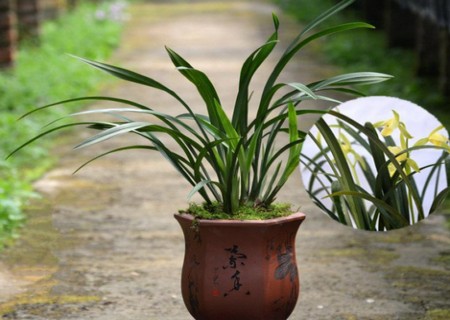
1. Choosing a pot
There are no high requirements for the flower pot. Choose a pot with a diameter of about 20 cm and a height of about 25 cm. Any pot with drainage holes at the bottom can be used to grow Cymbidium ensifolium.
Cymbidium ensifolium likes 3-5 seedlings clustered in one pot, which is beneficial for growth, for strong seedlings and for flowering. Generally, single-seedling planting is not advisable. Although a single seedling can tiller new shoots, it is not conducive to growth, and a single seedling will not flower. The basic requirement for orchids to flower is three plants connected together, and five leaves will surely flower.
2. Soil mixing
Fill the bottom of the orchid pot with small stones or broken tiles to one third of the pot height. For the growing medium, choose fired soil plus peanut shells, or pond mud dried into blocks and broken into granules; fired soil granules are the best.
3. Light
Light is the key to the growth of orchid seedlings; it determines the yellow-green color of the leaves and the height of the plant. If the light is too strong, the leaf color tends toward yellow and the orchid seedlings are strong and shorter; if the light is too weak, the leaf color is deep green and the orchid seedlings are thin and tall. The suitable light level is 65%-75% shade. Indoors on a table, choose a spot near the window, but it must not receive direct sunlight. This prevents scorched leaf tips. Maintain ventilation to prevent pathogen invasion.
4. Temperature
In a natural environment, it can be left to adjust naturally. For indoor cultivation, pay attention to the orchid's winter dormancy period, and adjust the year-round heat-preservation state. The suitable dormancy temperature for Cymbidium ensifolium is best between 0-12°C. Get through the dormancy period well, and next year's flowers will be more beautiful. If you do not seek flowers, no dormancy period is needed.
5. Watering
Although orchids appear noble, you must overcome the mindset of overindulging them and pay attention to their growth patterns. For watering, you must master the principle of watering when dry, not watering when not dry, and watering thoroughly. To judge whether the orchid pot needs watering, use as reference whether the orchid soil does not stick to the hand when touched, or whether the orchid soil has just turned white. When watering, be sure to water the entire pot evenly and thoroughly, to ensure that the orchid roots spread and distribute evenly. You can use a large basin to hold water, then place the orchid pot in the water and let water seep in from the bottom hole of the pot.
6. Fertilizing
As long as the orchid soil is good, generally no fertilizing is needed. For fertilizing, agricultural compound fertilizer can be used, 3-5 granules per pot each month is enough; never apply too much. Do not let the fertilizer come into direct contact with the orchid roots; after applying, cover it with orchid soil. For routine foliar water spraying, 0.1% potassium dihydrogen phosphate can be added. The root fungi of orchids can meet their nitrogen needs, so generally no nitrogen fertilizer is needed.
Precautions:
1. Dry/wet and cold/hot conditions determine whether to water more or less. In late spring and early summer when the climate is dry, water more; after autumn when the climate is dry, water more; in rainy summers and rainy autumns, water less; in the cool late autumn, winter and early spring, water less. On days with strong hot winds, water more; on days with frequent damp winds, water less.
2. If the orchid pot is on the dry side and the watering interval is prolonged, the leaf tips of the orchid often become scorched and withered. This phenomenon is also a signal that watering is possible, but it is already too late, because the orchid leaves have been damaged by thirst, and this damage cannot be cured.
3. There are generally 3 ways to water orchids. The first is soak watering. That is, soak three quarters of the orchid pot in water, and after the pot is soaked through, drain off the accumulated water. The second is pour watering. That is, pour water directly into the pot soil until the center of the pot soil is soaked. With this method, water pours in at the top and flows out at the bottom, so it must be poured repeatedly many times to achieve a thorough watering effect. The third is spray watering. That is, use a coarse-droplet spray head to spray water, wetting the entire orchid-growing environment, letting water seep from the soil surface to the upper part of the orchid roots to moisten the orchid pot. Expert orchid growers often use these three watering methods in combination according to the pot, with ideal results.
4. Orchids like sunlight but fear strong sunlight. According to this habit of orchids, home-grown orchids need shading. The amount of shading can reach 70%, that is, 70% of sunlight is blocked, and overall 30% sunlight exposure is sufficient.