What to Do If a Potted Peperomia (Peperomia obtusifolia) Has Root Rot? Detailed Explanation of Causes and Treatments
Peperomia is a very common small potted plant. In this article, we will discuss with fellow plant lovers what to do if a Peperomia has root rot. First, don't panic, because even if a Peperomia has root rot, there may still be hope of saving it. We can take advantage of the Peperomia's easy-to-propagate characteristic to re-propagate it.
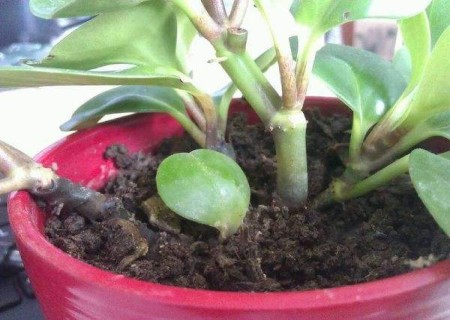
Let's first analyze the causes of root rot in Peperomia, so as to avoid making similar mistakes in the future. Generally, root rot occurs mostly because of long-term water accumulation. For example, some plant lovers grow their Peperomia semi-in-soil and semi-in-water. Although these methods are OK in the short term, in the long run they are not conducive to the growth of Peperomia, so it is still recommended to grow it in soil. Some plant lovers use nutrient soil or the like for their Peperomia, and watering frequently at high frequency over a long period causes the root system to become stuffy and damp, ultimately leading to root rot.
I. Causes of Root Rot in Peperomia
1. Temperature too high
Temperature also needs to be controlled when growing Peperomia. The most suitable growth temperature is 20-25°C, but in summer when the temperature is too high and the sunlight is strong, if appropriate cooling measures are not taken, the stems and leaves will turn black, leading to root rot.
2. Too much watering
Peperomia likes a humid environment. In an environment with relatively high air humidity, it does not need too much water. If watered too much at one time, it will cause poor root respiration and lead to root rot.
3. Improper fertilization
Peperomia has a high demand for fertilizer and water. When fertilizing, be careful to avoid the root system, so as not to burn the roots with fertilizer and cause root rot.
4. Disease
Root and crown rot is one of the diseases that Peperomia is prone to. It should be dealt with promptly. Generally, spray with a 1000-fold dilution of 50% carbendazim wettable powder.
5. Poor water quality
Peperomia can be grown hydroponically, but attention must be paid to water quality. If the water becomes sticky and cloudy, it needs to be cleaned and replaced with clean water; otherwise, the root system of the Peperomia will be contaminated and rot.
II. Treatment Methods for Root Rot in Peperomia
Treatment should be based on the degree of root rot in the Peperomia. Cases like the one in the picture below can still be treated. If the root rot is severe and both stems and leaves have rotted, there is no way to save it.
Now let's talk about what to do if a Peperomia has root rot. Actually, the method is very simple. First, take the Peperomia out of the pot, then rinse it clean, cut off the rotted parts, then let it dry in a cool, ventilated place for about an hour until the wounds heal, and then insert it into moist soil (pure sand, perlite, etc. are all fine).
Simply put, the solution is to make use of the principle that Peperomia is easy to propagate from cuttings. The part that has already rotted cannot be restored, so re-propagating from cuttings is the best solution, with a basic survival rate of 99%. Of course, some plant lovers like to root cuttings in water and then transplant them, which is also fine. As long as plant lovers remember that Peperomia is very easy to propagate, using this point to save it is the right approach.
III. Prevention and Control Methods for Peperomia Rot
Peperomia is neither cold-tolerant nor high-temperature-tolerant. Although its leaves are leathery and can prevent some water evaporation, and its requirements for environmental humidity are not high, in a high-temperature, high-humidity summer environment, if management is not strengthened, it is prone to rot.
In winter, when the temperature is too low, the leaves of Peperomia are also prone to rot from freezing. To prevent this, in summer the Peperomia can be placed in a shaded area for care, with attention to ventilation. Be sure not to overwater, but keep the potting soil moist. In winter, the potted plant can be placed in a sunny position, with room temperature kept at 12-15°C.
Root rot is truly one of the biggest killers of plants. So in order to avoid this situation, pay attention to the following points in daily care:
1. Water moderately
Water moderately, not too frequently. This is a mistake many beginners at growing flowers often make. Master the principle of watering when dry and stopping when wet. This should be paid special attention to during the dormant period of potted plants and the early stage of potting and repotting.
2. Fertilizer must be fully decomposed
The various organic materials mixed into the growing soil, such as leaf mold, pen manure, sawdust, farmyard manure, stable manure, organic waste, etc., must all be used only after long-term full fermentation and decomposition. Never use raw fertilizer; otherwise, when raw fertilizer ferments, the temperature will be too high and cause the root system to burn and rot.
3. Fertilize scientifically
When topdressing potted plants, the amount and concentration must not be too large. Try to follow the principle of "small amounts, many times." If the amount is too large, it will also burn and rot the roots.