How to Grow the Couple Begonia - Cultivation Methods for the Couple Begonia
The Couple Begonia, on a single flowering branch, blooms two flowers side by side: one single-petaled, which is the female flower, and one double-petaled, which is the male flower. Because they always open as a pair, everyone calls it the Couple Begonia. Occasionally, though, there are ones that bloom three flowers, and ones that bloom two pairs, but these are very rare. Of the ones I have grown, only one branch ever produced three flowers, and I did not take a photo. Two pairs, on the other hand, are quite common, and there are many varieties with rich colors - red, pink, yellow, orange and every shade in between.
The Couple Begonia has a full, rounded plant form, with alternate single leaves in an asymmetrical heart shape. Its flowers are large and brilliantly colored, making it a world-famous potted flower. Used to accent a living room or display window, it is charming and lovely; arranged in flower beds, along garden paths and at entrances, it looks especially graceful. Hung in a hanging basket in a hall, on a balcony or in a corridor, it is bright and vivid, particularly eye-catching.
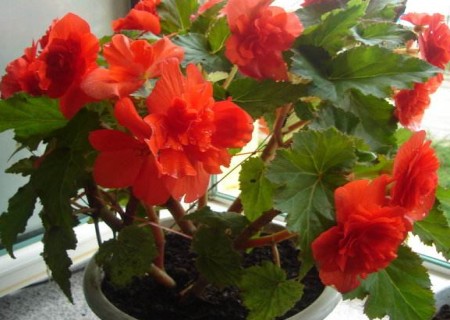
To grow the Couple Begonia, keep the pot soil moisture at 60% to 70%. Avoid full sunlight. Choose a substrate with good air permeability. At the same time, a well-ventilated environment will promote good growth in the Couple Begonia and keep it in a robust state. Today I will give you a brief introduction to the cultivation methods for the Couple Begonia.
I. Growing Conditions
1. Soil Requirements
The growing medium for the Couple Begonia can be made from plain sandy soil, or mixed from 2 parts peat soil and 1 part sandy soil. It requires good aeration and good drainage to avoid root rot.
2. Temperature Conditions
In terms of temperature, the Couple Begonia is much like the plum blossom - it is extremely cold-hardy and can withstand cold climates, growing well even at minus 15 degrees, so in the south, begonias can be grown outdoors without any problem.
3. Light Conditions
Plant growth requires sunlight, and the Couple Begonia especially needs to bathe in sunlight; it is suited to growing in an environment with plenty of light. If it grows in a shady spot for a long time, many adverse reactions will appear.
4. Watering Method
The Couple Begonia is cold-hardy, but that does not mean it is drought-tolerant. It should not be grown in a damp place; just keep the soil at a certain level of moisture without waterlogging, otherwise it will be affected by damp and develop root rot and yellowing leaves.
5. Fertilizing Method
In autumn, the Couple Begonia will shed its leaves, and a heavy fertilizing is required to ensure the nutrients it needs during growth. And when it sprouts in spring, organic fertilizer should likewise be applied, along with one thorough watering.
II. Key Technical Points
1. For potted Couple Begonias, a flower pot with a diameter of 15 cm is commonly used.
2. The growing medium is best mixed from leaf mold, peat soil and coarse sand, which is beneficial to the development of the begonia's root system.
3. After potting, during its growth, the amount and frequency of watering should be flexibly controlled according to the plant and changes in temperature. During the budding stage, watering should be strictly controlled, keeping the pot soil slightly dry, as too much moisture easily causes root rot. During the growing season, water the begonia 3-4 times a week, avoiding both excessive dryness and excessive moisture. Water by the rule: do not water when not dry, and water thoroughly when dry.
4. To increase air humidity, in the hot, dry summer, especially during the begonia's flowering period, frequently spray the leaves and the area around the pot with clean water and provide shade, placing it in a cool, well-ventilated spot.
5. Apply decomposed fertilizer water about once every 10 days. After the flower buds form, apply a phosphorus fertilizer such as superphosphate about once every 15 days.
III. Precautions
1. The Couple Begonia needs one pruning from after leaf fall to before spring budding. Cut off dead branches, weak branches and branches with pests or disease to keep it well ventilated and exposed to light. To ensure vigorous flowering, the long branches need to be cut back so that other axillary buds receive more nutrients; during the growing season, pinch out the growing tips in time to promote growth.
2. If watering is improper, or if the light is too strong and the temperature too high, the leaf edges will shrivel, the flower buds will drop, and the tubers may even die. Water 2-3 times a week, but do not shade it too heavily, otherwise the plant will grow leggy and produce fewer flowers.
3. When the Couple Begonia encounters a hot, humid environment during the growing season, stem rot and root rot often occur. Measures should be taken to control the room temperature and watering, and 25% carbendazim wettable powder at 300 times dilution should be sprayed on.