How to grow goldfish plant in water? Detailed guide to the correct method
Water-cultured spider plant is currently one of the most popular indoor foliage plants; placing a small seedling in a clean glass jar can maintain its ornamental value for two to three years. Do you really like the goldfish plant? Even when it is not blooming, you still love its green leaves, right? Recently, flower enthusiasts have been very curious about whether the goldfish plant can be grown in water, so let me give you a demonstration!
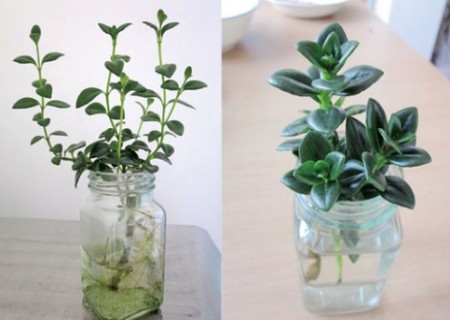
Can the goldfish plant be grown in water?
Fellow plant lovers who enjoy water culture, do you want to grow everything in water whenever you see it? Can that small pot of goldfish plant be grown in water? Don't you really want to give it a try? In the eyes of many plant lovers, as long as the stems can be stuck in water, it can be grown in water, and the goldfish plant is one of them. So it turns out the goldfish plant can indeed be grown in water!
Case study of growing goldfish plant in water:
I cut many stems of the goldfish plant and stuck them in a transparent glass bottle. After they slowly grew out, they spread in all directions in various shapes, looking much prettier than they did in a flower pot. When I have nothing to do, I look at their lazy postures spreading everywhere, which is very charming.
Growing the goldfish plant in water does not require very professional tools. Just pinch off a few stems, prepare one or more transparent glass bottles, and clean water, and that is all you need.
Insert the cut stems directly into the glass bottle, arranging them according to the size of the bottle opening, and do not pack them too densely. Generally, for an ordinary small bottle with a diameter of 3 to 4 cm, 3 to 4 stems are enough.
The stems in the bottle slowly open up and begin to spread in all directions in various shapes. The water-cultured ones look much better than the potted ones! When I have nothing to do, looking at their lazy postures growing in all directions feels really wonderful!
Looking at one pot after another, I simply cannot control myself!
What else is there to say? Paired with a cute little doll, it looks really beautiful, doesn't it!
Now you believe it, right? The goldfish plant really can be grown in water. What are you still waiting for? Pick up a container, fill it with water together, and let it bloom!
So, can water-cultured plants be kept together with fish? Here is a case study to explain:
Last weekend, Ms. Wang bought a pot of water-cultured spider plant. The plant above was lush and green, while the lively little goldfish below swam among the roots, one still and one moving, complementing each other beautifully.
However, a friend told her that keeping it this way would end with either the plant dying or the fish dying, which left her very conflicted.
Ms. Wang said the flower seller told her that there was no need to feed the goldfish. It could survive just by eating the rotting roots of the plant. In addition, the goldfish's waste could serve as fertilizer for the plant, "the two depend on each other."
But her friend's analysis also seemed very reasonable. The friend believed that the fish in the bottle would eventually nibble away all the plant's roots. Or, the spider plant would grow endlessly and compete for oxygen, suffocating the fish. "I don't know whom to listen to." Ms. Wang was very uneasy.
Regarding this question, the reporter consulted Ren Quanjin, deputy director of the Landscape Horticulture Department of the Zhongshan Botanical Garden. Ren Quanjin believes that the two can be kept together, and the key lies in routine care.
He explained that the rotting roots of water-cultured plants, plus the microorganisms already present in the water, are basically enough to sustain the fish's life. If that really is not enough, you can feed it a little food once a week.
In addition, he believes that when keeping water-cultured plants together with fish, you must change the water frequently, especially in summer. Furthermore, after adding fish, use less nutrient solution, and never use chemical fertilizers, as this will affect the fish's growth and may even endanger its life.
Precautions:
1. Growing water-cultured plants requires adding nutrient solution, and nutrient solution is not a good thing for fish kept together with plants! Some substances in the nutrient solution are harmful to fish, so they may very likely cause the fish to die.
2. Keeping fish requires adding feed, and adding feed will create conditions in the water for bacteria to survive, which is unfavorable for the plants, since after all what we are mainly growing is still the plants. But not feeding the fish is also not an option, so this degree must be well controlled, and the water must be changed frequently to maintain water quality.
3. This point actually goes without saying, and that is that tap water cannot be poured directly into the container. This is bad for both the plants and the fish. The chlorine in tap water is harmful to both fish and plants, so the water must be left to sit for several days before use. On this point, the fish and the plants are in "unanimous agreement."