How to grow a Peace Lily in water? A detailed guide to hydroponic cultivation
The Peace Lily (Spathiphyllum) has beautiful flowers and foliage, is light and graceful, grows vigorously, and symbolizes good fortune, making it highly favored by people. Hydroponically grown plants are suitable for placement in sunlit offices, living rooms, and studies, as well as in fresh and elegant settings. Adorning a living room or study with them is very comfortable and unique. Placing hydroponic Peace Lilies in hotel lobbies, at the front of venues, at station entrances and exits, and in shopping mall display windows makes them appear elegant and beautiful. Hydroponic Peace Lilies can regulate indoor temperature and humidity through transpiration, and can effectively purify volatile organic compounds from the air.
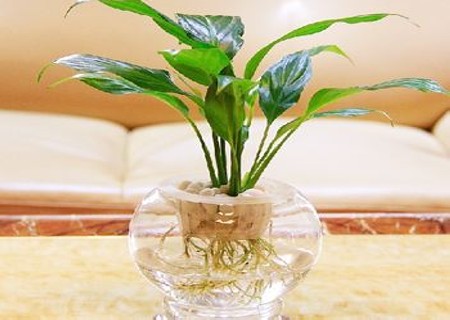
So, how do you grow a Peace Lily in water? Please follow along with the editor below! The following is the hydroponic method and process for Peace Lilies.
Hydroponic method/steps:
1. Take the previously prepared potted Peace Lily out of its pot and wash the roots;
2. Place the cleaned roots into a plastic basket, taking care to arrange them evenly;
3. Put some small stones in the plastic basket to help stabilize the plant;
4. Add one ear-spoon of monopotassium phosphate to purified water and stir well so it fully dissolves;
5. Pour one ear-spoon of monopotassium phosphate into the hydroponic bottle, then add purified water, making sure the water volume does not exceed 1/2 of the total bottle capacity, and stir well again so it fully dissolves;
6. Place the stabilized culture into the hydroponic bottle, and after these steps the job is done.
How is it? Simple, right! Flower lovers who enjoy hydroponic flowers should give it a try too!
Key points for hydroponics:
1. Material selection
Choose a flowering soil-grown plant as the material. After selecting the material, cut off old leaves and old roots, wash the root system, and if the plant is relatively large, divide the rhizome at the base to obtain several clumps of plants, each clump retaining at least 3-4 leaves.
2. Cultivation
The Peace Lily is a plant that is easy to grow hydroponically; its original root system can quickly adapt to hydroponic conditions, and root rot generally does not occur. After disinfecting the roots, soak them in rooting powder for about 15 minutes, let them dry, and then place them in a planting basket.
Place the planting basket into a hydroponic rooting bed for cultivation, using 1/3 dose of nutrient solution, with 1/2-2/3 of the roots immersed in the nutrient solution. Initially some old leaves may turn yellow and should be removed promptly. When the new roots reach 5-10cm in length, bottle them for sale.
For home cultivation, after washing the plant roots and disinfecting the root system, place the plant in a bottle and grow it in clean water, changing the water daily, and reduce the frequency of water changes after 1 week. Remove yellowed old leaves at any time, and when the new roots reach 5-10cm in length, cultivate with nutrient solution. (A 1-dose foliage plant nutrient solution can be used for cultivation)
3. Bottling
After removing the plant from the hydroponic bed, wash the root system. Because the Peace Lily plant is relatively large, you can choose a transparent glass container of a certain depth, set the planting basket on top of the glass container, and add nutrient solution to immerse 1/2 of the root system. The Peace Lily has a well-developed root system that is as white as jade, so cultivating it in a container with relatively high clarity gives a better ornamental effect.
4. Care
Place it indoors in a spot with bright, diffused light for care; the nutrient solution should be changed depending on the degree of water turbidity, and if it is clear it does not need to be changed; in summer the room temperature should be below 30°C. In winter the room temperature should be above 15°C; water should be sprayed on the leaves frequently. Pay attention to root trimming and cutting off withered leaves, and ensure the environment is well ventilated.