How to rescue a Phalaenopsis orchid with root rot? A few practical methods to teach you
Every Spring Festival, the Phalaenopsis orchid grows slender flower stems from its leaf axils, and then slowly blooms flowers that flutter like butterflies, adding plenty of festive Spring Festival atmosphere to the holiday. It is deeply loved by people and is honored as the “Queen of Orchids.” The Phalaenopsis orchid has graceful flower forms, dancing like butterflies, and is named for this, symbolizing nobility and elegance. A single Phalaenopsis orchid usually grows two flower spikes, and when the flowers bloom, the petals look like a crowded flock of butterflies, bright and eye-catching, like strung-together butterflies, very beautiful.
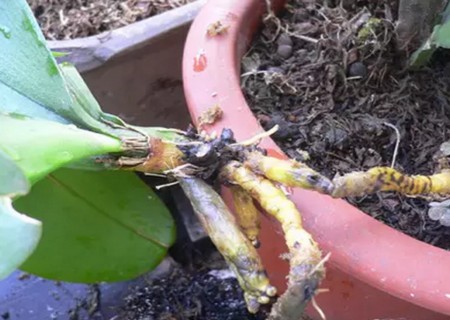
As an ornamental potted flower, the Phalaenopsis orchid has a beautiful appearance, delicate flowers, and a riot of colors. But what should you do if you find root rot during care? Below, the editor will explain the treatment and prevention of root rot in potted Phalaenopsis orchids.
1. Why do Phalaenopsis orchids get root rot?
The direct cause of root rot in potted Phalaenopsis orchids is improper water and fertilizer management. If watered too much, long-term water accumulation in the pot will lead to root rot; if fertilized too much, excessive nutrients accumulate in the pot and cannot be absorbed, and fertilizer damage will likewise cause root rot. Therefore, to avoid root rot, the first thing to do well is water and fertilizer management.
2. What to do if a Phalaenopsis orchid has root rot
1) Remove from the pot and clear the soil
When we find that a potted Phalaenopsis orchid at home shows root rot, we first need to take the plant, together with the soil, out of the pot, clean off the soil attached to the plant's root system, and then wash the plant's root system.
2) Prune the rotten roots
Next, use sterilized scissors to cut off all the rotten root parts, keeping as much of the intact part as possible. Doing this may allow the surviving remnant roots to be saved.
3) Disinfect the root system
After pruning, the remnant roots will have some wounds, which need disinfection treatment to avoid infection by pathogens that could trigger root rot again. Soak the root system in potassium permanganate solution for a quarter of an hour, then set it aside to dry. After that, apply a layer of plant ash to the wounds, and then it can be repotted.
4) Disinfect the soil
Before potting, we also need to disinfect the soil. You can pour boiling water over the potting soil, then spread it out to dry, and use it again after it cools down.
5) Repot
Once the preparatory work is complete, we can pot the plant. When potting, press the soil above the plant's root crown firmly, then water thoroughly once and place it in a cool, shaded place. Finally, cover the pot surface with a layer of plastic film; on one hand this can retain moisture, and on the other hand it can control temperature, letting the plant grow in an environment around 20°C. After about half a month, you can see new roots emerging, which means the plant has been successfully rescued.
3. How to prevent root rot in Phalaenopsis orchids
1) Soil mixing
Potted Phalaenopsis orchids have relatively high soil requirements; the soil mix should be loose, breathable, and highly permeable. It is recommended to use a combination of peat + perlite or peat combined with pine needles. If there is moss, moss can be used alone as the growing medium. Then apply some organic base fertilizer to the potting soil.
2) For watering, just keep the potting soil constantly moist, but avoid water accumulation in the pot, because as mentioned earlier, long-term water accumulation in the pot easily leads to root rot. When watering, pay attention to observing changes in the potting soil. If even a small amount of water cannot seep down, it means the potting soil is too compacted or there is water accumulation in the pot. You can insert a toothpick to judge whether there is water accumulation. If there is water accumulation, then you need to stop watering and drain it from the bottom or replace some of the soil with dry soil; if there is no water accumulation, then it should be because the potting soil is too compacted, and at this time we need to repot and change the soil to avoid causing root rot.