Planting Methods and Cultivation Techniques for Acorus calamus Bonsai
The ancient scholar Zhang Tingjiao said, "Acorus calamus (sweet flag) has the spirit of mountains and forests, not the air of wealth and nobility. It has a clean form, not a filthy one. Its pure qi rises beyond the dust of the world, its spiritual essence dwells among water and stone. This is a quiet treasure, this is a longevity treasure; those who appreciate it should cherish it."
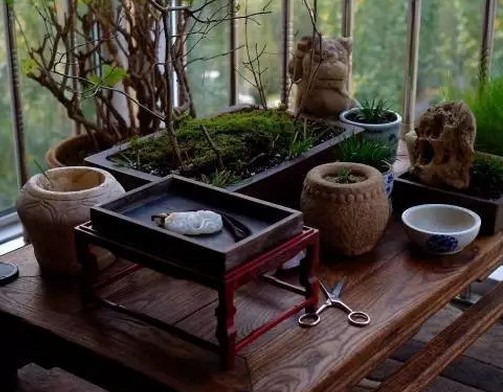
Regarding the classification of Acorus calamus, Zhang Han of the Ming Dynasty wrote in<松窗梦语>that there are six excellent varieties: Jinqian (coin), Niuding (ox-top), Huxu (tiger whisker), Jianji (sword ridge), Xiangmiao (fragrant sprout), and Taipu (Taiwan, China calamus). For pot cultivation as pure ornament, the three kinds most often used are Jinqian, Huxu, and Xiangmiao.
The ancient method of cultivating Acorus calamus: "Plant it in sand, and by spring trim and wash it; the more it is trimmed, the finer it grows, and in extreme cases the roots grow two to three fen long and the leaves about one cun long."
The modern mnemonic for cultivating Acorus calamus: "Plant near water, and it stays healthy attached to stone. Leaves dry, roots wet; it loves warmth and fears cold. Gentle breeze, shelter from rain; dividing it less often makes it thrive more. It loves shade and fears sun; it enjoys dew and avoids frost. Grown on stone it tends to be fine; planted in mud it grows quite sturdy. Apply light fertilizer and water generously; tend it often and pick off the yellow. Green as jade, its fragrance penetrates the organs. Its wild, untrammeled pure qi does not suit gaudy adornment. Paired with stone for pure ornament, kept in an antique pot. Simple and natural, it is best suited to the scholar's study."
In summary, "The Hard Road of Miniature Bonsai" sums up several key points for cultivating Acorus calamus:
1. The best time to divide Acorus calamus: Grain Rain (after the birthday of Acorus calamus on April 14, it enters its vigorous growth period);
2. Growing medium: loose sandy loam (a mixed soil of Xiantu, Zhijinshi, vermiculite, river sand, akadama, nutrient soil, etc.);
3. Fertilizing: place an appropriate amount of organic granular fertilizer on the pot surface (fertilizing Acorus calamus is also somewhat tricky; without fertilizer the leaves turn yellow, yet it does not tolerate much fertilizer);
4. Watering: leaves dry, soil wet (it likes moisture and fears drought. For daily watering, keeping the pot soil moist is appropriate, but too much watering can also easily cause yellow leaves);
5. Light: Acorus calamus likes shade, but still needs scattered light (it is recommended to place it in the shade of medium or large bonsai during normal care);
6. Leaf trimming: it is generally agreed that the more it is trimmed, the finer the leaves, but trimming should not be too frequent; regularly remove decayed leaves and yellow leaves to keep it at its best ornamental effect.
As one of the best companion plantings for bonsai, Acorus calamus, with its scholar's temperament, fragrant scent, and alluring color, is increasingly loved by miniature bonsai enthusiasts!
Sowing
Wash the collected ripe red berries clean, sow them indoors in autumn, keep the soil moist or in shallow water, and under conditions of about 20°C they will gradually sprout in early spring; afterward carry out separate cultivation, and when the seedlings grow robust they can be transplanted and set out.
Division
In early spring (around Qingming) or during the growth period, use a spade to dig out the underground stems, wash them clean, remove old roots, stems, and dead leaves and stems, then use a sharp knife to cut the underground stems into several blocks, each retaining 3-4 new buds, for propagation. To divide and plant during the growth period, dig up the plant with its roots, wash clean, remove 2/3 of the roots, then divide into blocks; when dividing, be sure to preserve the tender leaves, buds, and new roots.
Spacing
For open-field cultivation, choose low-lying land beside a pond; the planting spacing is 20 m for small blocks and 50 m for large blocks, but it must be based on the needs of the waterscape arrangement, and planting can be done in band-shaped, rectangular, geometric, and other layouts. The planting depth should keep the main buds close to the mud surface, while irrigating with 1-3 cm of water. For pot cultivation, choose a pot that does not leak, with an inner diameter of 40-50 cm, apply sufficient base fertilizer at the bottom of the pot, dig a hole in the middle and plant the rhizome, with the growing point exposed above the mud surface, and add 1-3 cm of water.
Fertilizing
Acorus calamus has strong adaptability during the growing season and can be managed extensively. During the growth period keep the water level or moisture, apply topdressing 2-3 times, and combine fertilizing with weeding. In the early stage, mainly use nitrogen fertilizer; before heading and flowering, mainly apply phosphate and potassium fertilizer; each time you fertilize, be sure to put the fertilizer into the mud (5 cm below the mud surface). Before overwintering, clean up the dead branches and fallen leaves of the aboveground part, and burn them in a pile or compost them. Open-field cultivation should be renewed every 2-3 years, and pot cultivation should be replaced and divided once every 2 years.
Soil
For cultivation, loam rich in humus is best, and sandy soil also grows well. The cultivation site should be chosen in semi-shade, avoiding direct strong sunlight; if it can receive 50%-60% light, it will naturally grow vigorously and the leaf color will be soft and beautiful. It likes moisture and nitrogen fertilizer; for fertilizing, use decomposed bean cake water or nitrogen, phosphorus, potassium, quick-acting No. 1, No. 2, etc., applying a small amount once every 20-30 days; a higher proportion of nitrogen fertilizer can promote lush leaves. The growing soil must be kept moist frequently; for small pots, a water tray can be placed under the pot bottom to maintain moisture. For indoor display, choose a place at the window edge where light shines in; if the growth vigor weakens, it should be moved outdoors promptly, watered fully, and given soft sunlight to recover its vitality. It likes warmth to high temperatures, and the suitable growth temperature is about 18-28°C. When it has been planted a long time and becomes too crowded, it should be forcibly divided, the soil changed, and then replanted.
Storage
Harvest 3-4 years after planting. In early spring or late winter, dig out the rhizome, cut off the leaves and fibrous roots, wash clean and sun-dry, and rub off the fine hairs to finish.