Black Pine Bonsai Bud-Forcing Techniques
Black pine has been a bonsai tree species much favored by bonsai enthusiasts in recent years, but how to make collected wild yamadori stumps sprout quickly is a problem many people hope to solve. Below, the editor will explain the bud-forcing techniques for black pine bonsai.
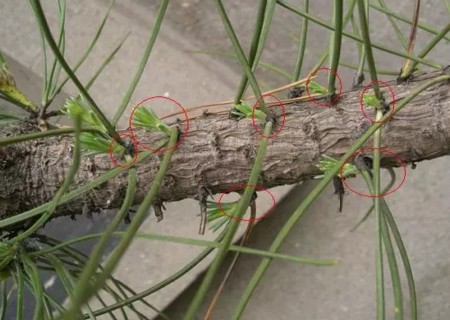
For the bud-forcing process of black pine bonsai, it is very important to retain old needles at the budding position; this is also one of the prerequisites determining whether buds can be successfully forced out, and it is likewise one of the important criteria we usually use when selecting black pine material for making bonsai.
The closer to the trunk the spot where black pine successfully sprouts needles is, the more space there is for shaping the plant; if the forced-budding part is too far from the trunk, this will undoubtedly be restricted in shaping. Moreover, it may not necessarily force out buds, so these forced "adventitious buds" depend on luck, and therefore forcing buds in this way carries a certain risk.
Forcing buds at a place far from the trunk, besides not necessarily succeeding in producing buds, also cannot achieve the same result as when old needles are reserved in advance, where needles can emerge wherever you want them to and branches can emerge wherever you want them to, because after all, only when needles emerge first can branches emerge. The method of reserving old needles can be fully intervened in and controlled by human effort, whether from different angles or different positions.
The season for shrinking branches and forcing buds on black pine, like a candle flame flaring wildly, is actually best for bud-forcing treatment at the point when the needles are about to unfurl.