How to care for potted carnations and points to note
Carnation (Dianthus caryophyllus), also called carnation, is a flower with brilliant colors and long-lasting blooms. Its form is delicate and its fragrance pleasant. It does not seek magnificence like the peony, nor does it strive for dazzling brilliance like the rose, and it certainly does not maintain rich, fragrant allure like the lily. Instead, the carnation is quietly elegant and fragrant, content and at ease, and is deeply favored by people. The carnation has a long flowering period, and its color, fragrance and appearance are all excellent, giving people a warm feeling and delighting the mood of the recipient.
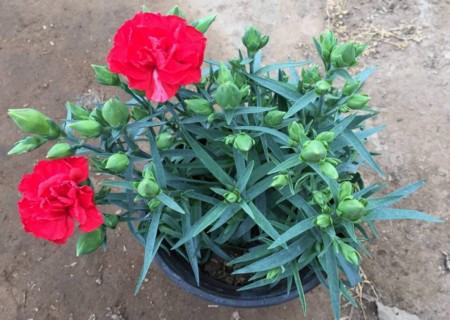
So how do you grow such a fragrant and pleasant carnation? How can you make its flowers last long and its fragrance spread all around? Below, the editor will explain the cultivation methods for potted carnations.
1. Soil
Carnations prefer a fertile, loose soil environment with good drainage. For potting, it is recommended to use calcareous or sandy loam. Mainly, do not plant continuously on the same land or plant continuously with other types of plants.
2. Light
Carnation is a sun-loving flower. Except during the seedling stage and flowering stage, it should be grown in a environment with sufficient light, because the longer the sunshine duration, the more it can promote the differentiation of flower buds in the plant, thereby increasing the amount and quality of flowering. During long periods of cloudy and rainy weather in winter, artificial lighting should be added. If it cannot get light for a long time, the plant will become weak and prone to various diseases.
3. Temperature
Carnation prefers cool conditions. During the day, it is suitable for growing at 19-21°C, and at night the temperature should preferably be kept at 9-10°C. Try as much as possible to avoid large day-night temperature differences, because too great a temperature difference easily leads to thin branches, narrower leaves, and flowers that are too small. When the summer temperature is higher than 35°C and the winter temperature is lower than 9°C, the plant will stop growing or develop problems. Therefore, temperature control measures should be taken well in these two seasons.
4. Watering
Carnation has relatively high humidity requirements, and it is best to keep it between 70-80%, but in winter, because the light period is short and the light is weak, water should be appropriately controlled, which can prevent the branches from growing too thin. Watering carnations should be determined according to the condition of the plant itself. If the leaves are bright and crisp and tender, and the leaves bend and break easily, it means it is not short of water; if the leaves do not bend and break easily, it means it is short of water and needs timely replenishment. In addition, you can also judge whether it is short of water by inserting a dry twig into the bottom of the pot. When watering, you should water thoroughly, and be careful not to wet the leaves.
5. Fertilizing
When potting carnations, sufficient base fertilizer containing potassium, calcium, nitrogen, and phosphorus should be applied at the bottom of the pot. During the growing period, apply a thin decomposed liquid fertilizer once every two weeks, and apply one topdressing after flowering. Note that fertilization cannot be done during the high-temperature summer season, otherwise it is easy to cause fertilizer damage, causing the plant to wither or even die.
6. Pruning
In order to keep potted carnations in a graceful plant shape, make their posture more beautiful, and at the same time make the flowers more brilliant, we should prune the plant at the appropriate time. When the plant grows to about 20 cm, it needs to be topped, and usually it is enough to keep 6 or 7 side buds; afterward, proper pinching is also needed to let the plant sprout side branches; for flower buds, thinning should be done appropriately, removing the side buds and side shoots in the lower leaf axils; the second time should be carried out before mid-August.
7. Diseases
Carnations are susceptible to diseases such as rust and leaf spot. In addition to paying attention to observation at ordinary times, prevention and control management should also be strengthened. According to the specific symptoms, corresponding medicines should be used promptly for treatment.