Causes and Solutions for Yellowing Leaves on Potted Rubber Plants
The rubber plant (Ficus elastica) is a very beautiful indoor foliage plant, generally grown in pots in the living room. As long as it grows well, it can bring us many benefits, such as purifying the air, beautifying the environment, and playing a feng shui role. The premise is how to keep it in good growing condition. Many plant lovers encounter various problems when growing rubber plants, and yellowing leaves are the most common phenomenon.
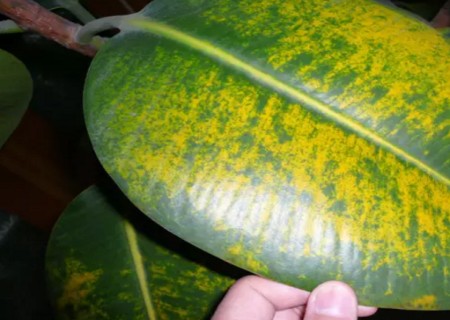
Yellowing leaves on potted plants is a fairly common phenomenon, and it is usually caused by inadequate care and management. So, what should you do when the leaves of a potted rubber plant turn yellow? We first need to find the root of the problem, and then treat it according to those causes. Only in this way can we save our potted rubber plant from its sorry state.
1. Compacted potting soil
In a previous article, the editor mentioned that potted rubber plants should be repotted starting from the seedling stage, because if they are not repotted for a long time, the potting soil becomes compacted and the nutrients in the soil become fewer and fewer. Especially after the soil becomes compacted, the plant's root system cannot breathe properly, which leads to suffocation. The plant will develop yellowing leaves due to lack of water and nutrients, and if effective measures are not taken in time, the plant will soon die.
For yellowing leaves caused by overly compacted potting soil, we should first choose a suitable time to repot the plant promptly, and at the same time prune away the dead parts of the root system. After reorganizing the plant, fill it in with loose, breathable new soil.
2. Temperature too low
According to the growing habits of the rubber plant, we know that the plant can overwinter safely only when the temperature is not lower than 5°C; if the temperature of its growing environment is below this value, the plant will develop yellowing leaves and even leaf drop.
For yellowing leaves on the rubber plant caused by too low a temperature, the first thing we should think of and do is to immediately take measures to keep it warm, bringing the temperature of the plant's growing environment up to 5°C in the shortest possible time, while supplementing with other recovery measures. It should soon return to a state of green leaves.
3. Lack of nutrients
The rubber plant not only likes a moist growing environment, but also loves fertilizer very much. As long as there are enough nutrients, it will keep growing. Conversely, if the plant grows for a long time in poor potting soil and cannot get enough nutrients for growth, it will show poor growth. Not only will the leaves become thinner, but yellowing leaves are also very likely to appear.
If the yellowing leaves are caused by a lack of essential nutrients for growth, we should repot it at the right time, add a sufficient amount of base fertilizer to the potting soil, and then prune away the yellow leaves. Afterwards, apply a dilute liquid fertilizer mainly based on phosphorus and potassium fertilizer about once every half a month. Once the plant's growth stabilizes, the yellow leaves will disappear completely.
4. Over-fertilization
In the previous point, the editor analyzed for everyone the phenomenon of yellowing leaves on potted rubber plants due to long-term lack of nutrients. So, if too much fertilizer is applied, or the liquid fertilizer concentration is too high, will it cause yellowing leaves? Absolutely. If too much fertilizer is applied or the liquid fertilizer concentration is too high, it is very easy to cause fertilizer damage to the rubber plant, and its leaves will also develop fertilizer-induced yellowing.
For fertilizer-induced yellowing of rubber plant leaves caused by excessive fertilization or too high a liquid fertilizer concentration, the first thing to think of is to save it by repotting. Because the fertilizer effect is too much and the fertility is too strong, the soil in the original pot will not do. Take the plant out of the original pot, prune away the roots that have already rotted, and after repotting and replanting, fill it in with moist new soil. Be careful not to continue fertilizing for the time being, but you can spray water on the leaves to keep them moist, while also diluting the nutrients in the plant.
5. Air-related causes
If the indoor space is not ventilated enough or the air is too dry, this can also easily cause yellowing leaves on potted rubber plants, and the older leaves on the lower part of the plant are also very likely to wither, yellow, and drop. If the air is too dry, the potting soil and leaves will not get water replenishment due to evaporation; and if indoor air circulation is poor, harmful gases will gather together and reach too high a concentration. Both of these situations will cause rubber plant leaves to turn yellow.
For the above situations, on the one hand, immediately improve ventilation conditions, and at the same time do a good job of water replenishment to increase the moisture of the potting soil and the air. You can move the flowerpot next to the windowsill and open the window to allow ventilation; at the same time, water the pot in time, and spray water on the leaves and the ground to increase air humidity. As long as the growing environment of the potted rubber plant is suitable, the plant will quickly return to a normal growing state, and the yellow leaves will gradually disappear. (Author: Xiaoshu 22:40)