What to Do When Fittonia Drops Its Leaves? Causes and Solutions
As a houseplant grown for its foliage, the Fittonia's greatest ornamental feature is its leaves, which are famous for being covered in white net-like veins. Since it is a foliage plant, once it starts dropping leaves, it is bound to seriously ruin the viewer's good mood. People all like to look at beautiful things, and once something beautiful turns ugly, it makes people unhappy.
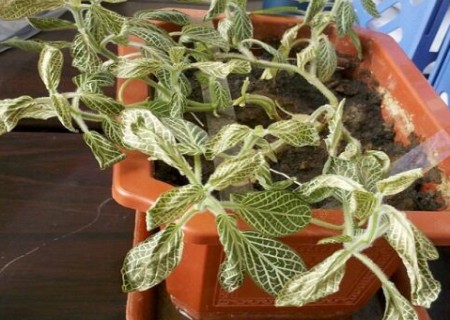
In fact, when your care and management methods are not right, leaf drop in Fittonia is unavoidable. So why does Fittonia drop its leaves? And what should you do about it? First of all, don't panic, because worrying won't help. We need to learn to face the problem calmly, think it through, and thereby find a way to solve it.
1. Direct Sun Exposure
Many potted flowering plants quite like the sun, but they cannot tolerate harsh direct sunlight; otherwise, in mild cases the leaves wilt and drop, and in severe cases the plant dies. This is exactly what happens with Fittonia: when the direct light is too strong, it drops its leaves.
When a potted Fittonia drops its leaves due to sun exposure, we should immediately provide shade for it, or simply move it indoors to a bright spot near a windowsill so it receives only scattered light; it can even go without light for a short period. This is because Fittonia also has a certain tolerance for shade, and even if it receives no light for a short time, its growth will not be affected.
2. Temperature Too Low
Leaf drop caused by unsuitable ambient temperature is really not a common phenomenon. But this is exactly the case with Fittonia: when the winter temperature is too low, especially below 15°C, the plant will drop its leaves. Under such conditions, the plant naturally cannot make it through the winter smoothly.
In view of this, we should immediately take measures to keep it warm, and can promptly move it indoors to a warm place. Usually, as long as the temperature of the plant's growing environment stays above 15°C, it can safely overwinter, and naturally it will not drop its leaves. Of course, on sunny days, when the temperature rises, you also need to promptly move the plant outdoors so it can fully soak up the warm winter sun, and then move it back indoors once the temperature drops.
3. Improper Watering
Improper watering is the most common trigger for growth problems in flowering plants; generally, when a plant has problems, the first thing we need to check is whether improper watering is the cause. If you water too much, or if the potting soil has become compacted and cannot drain properly, water will accumulate in the pot, which in turn causes leaf drop. Of course, if the air humidity is too high, that can sometimes cause leaf drop as well. In short, if the Fittonia's growing environment is too damp, it will very easily drop its leaves.
So we must master good watering techniques in normal care: not too much, not too little, just the right amount. Watering should be done as appropriate according to the plant's current growth needs. When Fittonia is in its growing period, its water demand is greater, so watering should be increased; especially in the dry summer season, besides increasing watering, you should also spray water on the leaves and the ground to raise air humidity and at the same time achieve the goal of cooling. When the winter temperature is lower, in order to ensure the plant can overwinter smoothly, we should strictly control watering, and when necessary, decisively stop watering to keep the potting soil on the dry side. (Author: Xiaoshu 2017-09-12 22:38)