What to Do When the Leaves of a Chinese Juniper Bonsai Turn Yellow? Cause Analysis and Control Measures
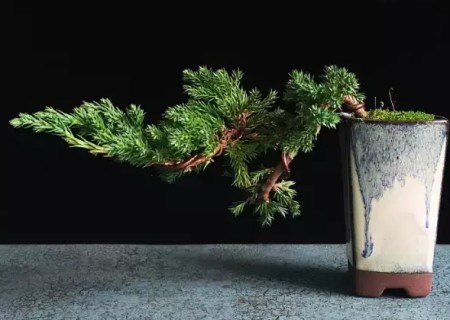
Ground juniper, also known as creeping juniper and prostrate juniper, is an evergreen shrub of the genus Juniperus in the cypress family. The plant is low-growing, with no upright trunk; its branches grow in a creeping manner, parallel and slanting upward or close to the ground. The bark of the trunk is smooth when young and becomes rather rough after growing for some time. Its branchlets grow densely, and the leaves are needle-like with pointed tips, about 0.8 cm long, borne in whorls of three. When used to make bonsai, it has the characteristics of dense branches and leaves, emerald green color, evergreen throughout the four seasons, distinct layers, and an elegant posture.
The branches and leaves of ground juniper are emerald green, winding and creeping, and it is suitable for viewing in all four seasons, with the best ornamental effect when the tender green new branches and leaves sprout in spring. During the growing period, it should not be placed indoors for a long time. Ground juniper is easy to shape and can be made into a horizontally spreading symmetrical bonsai, placed in a courtyard or reception room for appreciation. Ground juniper is often planted in rock gardens or lawn corners in landscapes, and is also a good ground cover plant for gentle slopes. However, if managed improperly, ground juniper will show yellowing of leaves, mainly for the following reasons:
1. Causes related to fertilizer and water
Although ground juniper is suitable for growing in dry sandy soil, if it is kept for a relatively long time in an environment with drier soil and dry air, the leaves on the lower part of the branches tend to turn white and yellow. If it is not a grafted seedling, especially not a grafted seedling using Chinese arborvitae as rootstock, this situation is even more likely to occur. Water should be applied in an appropriate amount until thoroughly watered. Ground juniper requires a loose, well-aerated ecological environment. If the soil remains excessively wet for a long time, the plant will suffer root rot due to lack of oxygen, and the leaves will turn yellow, especially the new leaves. Watering should be controlled and the soil loosened for aeration. Sometimes excessive fertilization can also cause yellow leaves, which should be controlled.
2. Diseases
The mycelium of juniper rust overwinters on cypress plants and alternates to Rosaceae plants such as crabapple, hawthorn, pear, and apple. The disease mainly harms the needles and tender shoots of ground juniper. In the early stage of the disease, small orange-yellow, glossy lesions appear on the leaves, then gradually expand, and on the lesions appear small yellow dots the size of pinheads. When the weather is humid, mucus is secreted on them, and after drying, the yellow dots turn black, which are the spermogonia of the pathogen. The following year, when rain occurs, they germinate and produce basidiospores, which are spread by wind. In warm and rainy years in spring, the disease is severe. If scattered yellow spots appear on tender branches and leaves, it is generally this disease.
Control measures:
1. Prune diseased branches in winter:
2. From October to November, spray a mixture of 0.3% pentachlorophenol and 1 degree Baume lime sulfur on ground juniper, which can prevent infection by rust spores;
In mid-to-late March, before the teliospores germinate, spray 1-2 degrees Baume lime sulfur or an equal-amount 160-200 degree Baume Bordeaux mixture 2-3 times, once every 7-10 days, for a relatively good effect.
In addition, if a large area of prostrate ground juniper turns yellow, no pests or diseases are found, and the soil moisture is moderate, it may be physiological yellowing disease of ground juniper. The symptoms of yellowing disease are that the leaves turn yellow in the early stage of damage, then become yellow-white, most obviously in new leaves. In severe cases, the leaf tissue necroses, affecting normal photosynthesis, and then the whole plant slowly dies. This is usually because the soil and water in northern regions contain more alkali, affecting the plant's absorption of iron ions, causing physiological iron deficiency in the plant and leading to yellowing disease.
Control measures:
1. Ferrous sulfate can be mixed into fertilizer and applied. Mix 2.5 kg-3 kg ferrous sulfate, 5 kg-7.5 kg oil cake, 10 kg-15 kg manure, and 200 kg-250 kg water, and use after it decomposes and turns black.
2. Spray a 0.2‰ ferrous sulfate solution, covering both the front and back of the leaves, once every 3 days, for several consecutive times, to improve the yellowing of tender leaves.
3. Pests
If ground juniper turns yellow in patches, after excluding disease, it may be damage by trunk-boring pests (such as longhorn beetles). Carefully check the branches and trunk to see whether there are frass holes. Or break off a withered yellow branch to see whether there are pest tunnels caused by longhorn beetles.
Control measures:
1. Strengthen the maintenance and management of ground juniper to enhance tree vigor and reduce opportunities for pest invasion.
2. Use a syringe to inject 80% dichlorvos emulsifiable concentrate diluted 30-50 times into the borer holes in the branches and trunk of ground juniper to poison the larvae. Before injection, remove wood shavings and insect frass from the tunnels; after injection, seal the tunnel openings with clay.
3. If the pest damage is severe, they can be removed and burned in a concentrated way.
The causes of yellowing leaves in ground juniper are sometimes single and sometimes the result of a combination of multiple causes, so it is necessary to analyze carefully, diagnose thoroughly, and apply the right treatment.
[Maintenance suggestions]
1. Watering: Ground juniper likes moisture, and potted plants should be watered frequently, but should not be waterlogged. In dry weather, it is advisable to spray water on the leaves often.
2. Fertilization: It is advisable to use dilute, decomposed organic fertilizer. From March to May in spring and from September to October in autumn each year, apply dilute fertilizer water 2-3 times each.
3. Pruning: For pruning ground juniper, before new branches sprout in spring, shorten side branches that do not need to develop in time to promote the extension of the main branches. Branches that affect the tree shape can also be pruned during the dormant period.
4. Repotting: Ground juniper should be repotted once every 3-4 years, preferably before budding in early spring. When repotting, part of the old roots and old soil can be properly removed and replaced with fertile, loose culture soil, to promote the growth and development of new roots, strong branches and emerald leaves, and increase the ornamental effect of the bonsai.
5. Placement: Ground juniper should be placed in a shaded, relatively humid place, but it must be well ventilated. It is best to place the pot close to the ground, and in winter bury it in soil to overwinter outdoors.