Reasons and Solutions for Withered and Yellowing Leaves on Acorus calamus
Acorus calamus, seemingly an ordinary clump of wild grass from the mountains and fields, especially in places near water sources, is yet deeply favored by scholars and refined gentlemen. However, Acorus calamus is a plant of remarkable character, its elegant and graceful posture displaying an extraordinary bearing. Placing a pot of Acorus calamus bonsai on one's desk, with fragrance lingering among the verdant leaves, gives infinite reverie.
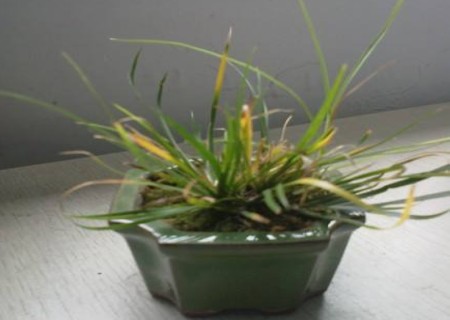
As the saying goes: “Painting bamboo is hard to top off, growing Acorus is hard to green the tips.” The difficulty in growing Acorus calamus lies in making the leaf tips turn green, otherwise its ornamental effect will be affected. So, what should be done when Acorus calamus leaves wither and turn yellow? A normally growing Acorus calamus is generally verdant all over. When this situation occurs, it is undoubtedly a problem that has arisen during care.
1. Water-yellow appearance
Acorus calamus relatively prefers moisture, and generally an occasional extra watering does no harm, as long as the pot's drainage is good enough. But if water accumulates in the pot due to poor drainage or poor substrate permeability, it will naturally affect the root system's respiration, thereby causing root rot. So, over time, the leaves will show a water-yellow appearance, accompanied by withering.
For this phenomenon, we first need to control watering and place the Acorus calamus bonsai in a ventilated spot to air out and accelerate evaporation. If the substrate's permeability is poor, then it needs to be replaced promptly. As long as these two aspects are handled well, the Acorus calamus will soon return to normal growth, believe it or not.
2. Drought-yellow appearance
Above, the editor mentioned the phenomenon of water-yellow and withering in Acorus calamus caused by water accumulation in the pot. In fact, if Acorus calamus is deprived of water for a long time, a similar phenomenon will also occur, but the yellowing color takes on a drought-yellow appearance, which likewise affects the ornamental effect. As everyone knows, Acorus calamus prefers moisture and does not tolerate drought, especially in high-temperature weather, so we must take timely water-supplementing measures.
When Acorus calamus shows drought-yellow and accompanying withering, we should water it promptly, but not with an excessive amount at one time. Because Acorus calamus that has been in a drought state for a long time will find it hard to adapt when suddenly given a heavy watering, which will cause even more problems. So it needs to gradually increase watering after it adapts. Watering during this period is a step-by-step process; do not rush for quick results and flood it all at once.
3. Dry-yellow appearance
Dry-yellow is not entirely the same as the previous two phenomena, or rather, it is quite different. Dry-yellow in Acorus calamus is mainly caused by excessively low air humidity in its growing space, especially prominent in air-conditioned rooms in summer or heated rooms in winter. Once the air humidity becomes too low, if not improved in time, Acorus calamus is very prone to dry-yellow, and in severe cases it will even wither.
For the dry-yellow phenomenon in Acorus calamus, we first need to increase watering, while also artificially creating a high-humidity environment to raise air humidity. In addition, if it is summer, necessary shading measures should also be taken, or it can simply be moved to a cool, ventilated place for care.
4. Scorch-yellow appearance
Acorus calamus not only prefers moisture but also relatively prefers shade, so it has a certain shade tolerance. During normal care and management, it only needs to be placed in a spot that receives scattered light. On sunny winter days, since the sunlight is relatively mild, it can be directly exposed to light. If the light is too strong and no shading measures are taken in time, Acorus calamus is prone to a scorch-yellow color, seriously affecting the ornamental effect.
Scorch-yellow is mostly caused by excessively strong direct light. Since Acorus calamus likes a shaded environment, it only needs appropriate shading, especially when the light is strong, we need to take shading measures. It is recommended to place it under tree shade so it receives scattered light.
5. Alkaline-yellow appearance
Acorus calamus likes to grow in a slightly acidic growing environment. When either the substrate or the water is alkaline, or when the pot has not been changed for a long time and excessive saline-alkaline components accumulate in the pot, its stems and leaves are prone to turning from green to yellow, thus showing an alkaline-yellow appearance, which likewise reduces the ornamental value of the Acorus calamus bonsai.
To solve this situation, we need to look at the degree of alkaline-yellow to decide. If the alkalinity in the pot is not too strong and the Acorus calamus only shows slight alkaline-yellow, then we can use a diluted ferrous sulfate solution to neutralize it, to reduce alkalinity and keep the pot slightly acidic. If the degree of alkaline-yellow is too deep, then it is recommended to directly change the pot and soil!
6. Frost-yellow appearance
The most suitable growing temperature for Acorus calamus is between 15-25°C. When the temperature drops to 10°C, its growth becomes very slow; if the temperature drops to 5°C, it is easily frostbitten with the slightest carelessness, causing the stems and leaves to show yellowing. This yellowing is usually defined as frost-yellow, and in severe cases the plant will wither.
When Acorus calamus shows frost-yellow, we should immediately place it in a warmer place for care, hoping its roots and stems and leaves can quickly regenerate. But the temperature difference before and after should not be too great, otherwise it is prone to causing new growth problems. When keeping it warm, it is recommended that the temperature be raised gradually, mainly to let the Acorus calamus gradually adapt to the warming process.
Overall, when Acorus calamus shows yellowing, or even withering, leaves, we must first find the cause, which is mainly manifested in the above aspects. Once the cause is found, we should promptly apply the right remedy, hoping the Acorus calamus leaves will turn from yellow to green as soon as possible. Moreover, the causes of yellowing Acorus calamus leaves are not all the same, so we should treat them seriously and investigate carefully in order to achieve a perfect solution to this problem.