What to do when a potted Schefflera (umbrella plant) has yellowing leaves? Causes and solutions
The branches and leaves of the Schefflera are very distinctive, and its leaves stay evergreen with a glossy sheen, making it a rare indoor foliage plant. However, as a foliage plant, it can often develop yellowing leaves when its growing environment is disrupted. The Schefflera, being a foliage plant quite suitable for indoor cultivation, is no exception. So what should you do when a potted Schefflera has yellowing leaves?
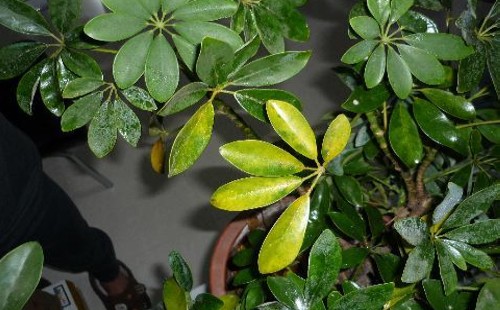
To know what to do, we first need to identify the cause, so that by taking effective measures we can change the situation and help it quickly return to a normal growth state. The yellowing of Schefflera leaves is usually caused by improper care and management that creates problems in the environment suitable for its growth, so the plant shows this poor-growth symptom.
1. Improper lighting
The Schefflera prefers a semi-shaded growing environment, but plants need light to carry out photosynthesis. If the growing environment is too shady for a long time, the plant cannot carry out photosynthesis normally due to lack of light, which affects its growth and causes yellowing leaves; while too strong light will cause the plant's dense branches and leaves to release too much water, and when the water cannot be replenished effectively in time, yellowing leaves will also appear. Therefore, during the growth of the Schefflera, it is necessary to provide it with suitable lighting.
2. Improper watering
The Schefflera prefers a moist growing environment, and usually you only need to water it promptly when the potting soil feels dry, combined with misting. Original If the potting soil or air humidity is too dry, yellowing leaves often appear; but if overwatering damages the root system, similar problems can also be triggered. Therefore, watering should be timely and moderate. In spring, summer and autumn, it is usually enough to water once every 3-4 days, while in winter watering must be strictly controlled, but it should also be considered as appropriate based on the dryness and moisture of the potting soil and the air humidity.
3. Improper fertilizing
Improper fertilizing may be either excessive fertilizing, or not fertilizing for a long time or fertilizing too little, all of which can easily cause yellowing leaves in the plant. Excessive fertilizing mainly means the concentration is too high and the fertilizer effect is too strong, causing the roots to be burned and affecting their normal ability to absorb. When the plant cannot get water and nutrients, this condition occurs. And when the plant lacks fertilizer for a long time, this is largely similar to excessive fertilizing: when the plant likewise cannot absorb the nutrients needed to sustain its growth, it cannot meet its growth needs and yellowing leaves appear. Therefore, fertilizing potted Schefflera should not only be timely, but also scientific and reasonable, and especially the concentration must be well controlled.
4. Disease infection
When a plant is attacked by diseases such as leaf spot, the leaves often also turn yellow. It is just that the yellowing caused by disease differs from the other situations: usually when the disease occurs the leaf color appears brown, but in severe cases it turns yellow. Moreover, when leaves turn brown or yellow due to infection, this usually spreads gradually from small patches to larger ones. So once you find this situation, you should promptly use the corresponding medication to spray and kill it.
Yellowing leaves in foliage plants are mainly caused by the above factors, so when carrying out routine care and management, you must be reasonable and rigorous. Although this phenomenon is fairly common, we still need to do our best to prevent and treat it, otherwise it not only affects the ornamental value, but in severe cases may even cause the plant to die. Therefore, do not let your plant develop various growth problems because of your neglect or improper management.