What should I do if the leaves of a potted Buddha belly bamboo (Bambusa ventricosa) dry up and turn yellow?
Potted Buddha belly bamboo is often highly ornamental for its elegant plant form and emerald green leaf color. However, once the leaves dry up or turn yellow, its ornamental value is greatly reduced. Clearly, when this happens, the plant must have developed a problem in its growth. The phenomenon of Buddha belly bamboo leaves drying or turning yellow mostly occurs in summer, so we need to promptly investigate the cause, take proper countermeasures, save it as early as possible, and let it sprout green again and show itself in a beautiful form.
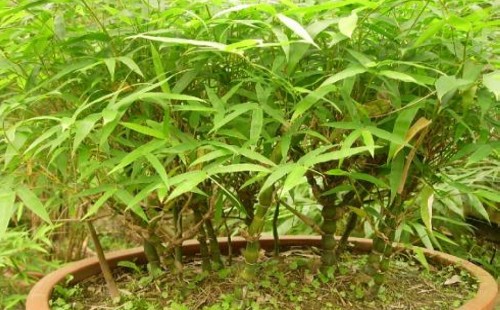
Through practice, it has been found that in summer, Buddha belly bamboo is prone to leaves drying up or turning yellow, mainly due to an unsuitable environment. And the situation of an unsuitable environment is often caused by various factors. Generally, when factors such as long-term exposure to scorching sun, insufficient air humidity, insufficient nutrients in the pot, and damage from pests and diseases occur, the growing environment originally suitable for potted Buddha belly bamboo is disrupted. This leads to the potted Buddha belly bamboo becoming unsuited to the environment, so it often shows the phenomenon of leaves drying up and turning yellow. Below, let us look at this in detail.
1. Excessive light
Many potted flowering plants are afraid of the scorching sun in summer. Even some relatively drought-tolerant plants often develop various growth problems due to long-term exposure to the scorching sun. Buddha belly bamboo is no exception. If it is placed outdoors for a long time, under the baking of the scorching sun, the evaporation of water from both the potting soil and the branches and leaves is very large. For a time, the root system cannot effectively supply water, and the plant will enter a self-protective state due to lack of water. The branches and leaves often dry up or turn yellow, or even fall off, to reduce water consumption. Therefore, in response to this situation, we should promptly take shading and cooling measures for the plant.
2. Dry air
For the same reason as excessive light, the plant needs to consume a large amount of water in summer. Original The leaves of Buddha belly bamboo are closely related to air humidity. The moisture in the leaves and the moisture in the air often form a balance between evaporation and absorption. Usually, only when air humidity and the evaporation of moisture from the branches and leaves are in this balanced state can the plant maintain normal growth and avoid poor growth due to water problems. If this balance is broken by factors such as excessively high summer temperatures, overly hot weather, and too strong light, especially when air humidity is too low, then the plant will show leaves drying or turning yellow. Therefore, we need to replenish water for the plant in time, especially by spraying water on the branches and leaves more often to cool and moisturize. Only when the air humidity is suitable can the situation usually be improved.
3. Insufficient nutrients
If potted Buddha belly bamboo has been grown in a pot for a long time without timely fertilization, after the nutrients in the potting soil are exhausted, the plant cannot obtain additional nutrient supplementation, and it is very prone to growth problems. This usually shows as new shoots growing weak and small, and old branches and leaves turning yellow and withering prematurely. In fact, this is also a way for the plant to rest and adjust itself. Because there are not enough nutrients to maintain normal growth, the plant often reduces its own branches and leaves to save nutrients and sustain life. This is also a typical feature of self-protection. Therefore, we should topdress fertilizer in time, but the fertilizer concentration must be low enough, with dilution being essential; otherwise, it will cause fertilizer damage and worsen the symptoms.
4. Damage from pests and diseases
If in summer the potted Buddha belly bamboo is kept for a long time in a high-temperature, hot and humid environment, and ventilation is not very smooth, the plant is very likely to breed and become infected with various pests and diseases. When the plant suffers damage from these pests and diseases, it often shows phenomena such as branches and leaves drying up, turning yellow, and even leaf drop. Once the plant is found to be infected with pests or diseases, especially when the symptoms are relatively obvious on the branches and leaves, we should promptly spray it with medicine to sterilize and kill insects.
Of course, there is another situation: when the temperature in midsummer is too high, the plant will enter a dormant state when it cannot endure it, and this will also cause the branches and leaves to wither and turn yellow. As for this situation, it is usually a normal phenomenon in the plant's metabolic process, and normally it is enough to spray more water.