How to grow dwarf asparagus fern so it stays compact and doesn't grow vines
The branches and leaves of asparagus fern are not only rather slender, but their leaf color is also fresh and vivid green. Combined with its elegant and graceful plant shape, it has considerable ornamental value, and it often brings a feeling of fresh, light greenery, which is why it is very popular with the public. But when growing it as a bonsai plant, it is usually necessary to choose dwarf asparagus fern varieties. Not only that, dwarfing measures must also be done well.
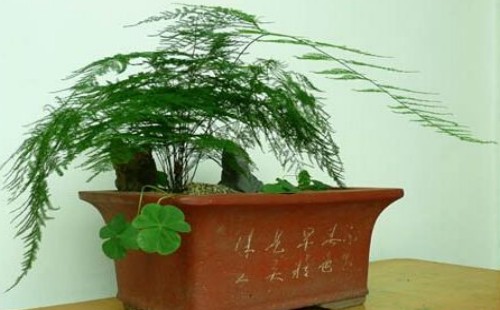
Asparagus fern is also a plant with long stems and vines, so it has a strong climbing ability. If effective care measures are not taken in time and it is allowed to grow wildly on its own, it can reach a height of several meters. When the branches and stems cannot support the weight above, they will inevitably fall over in all directions, or even break in the middle, thus losing the ornamental value of the bonsai. So how should dwarf asparagus fern be grown so it stays compact and strong without growing vines?
For young asparagus fern plants, during the peak growing seasons of spring and summer, first of all, do not apply a large amount of fertilizer. In general, it is enough to keep applying fertilizer once a month, and each time the concentration and amount of fertilizer applied should not be too large. Fertilizing should be like its branches and leaves, mainly light and dilute. For older plants, fertilizer is generally not needed, or should be applied as little as possible. At the appropriate time, it is enough to reasonably repot and change the soil. In this way, whether it is a young asparagus fern plant or an old one, stable growth can often be maintained.
But besides applying less fertilizer, we also need to frequently carry out pruning. Especially when nutrients are sufficient, asparagus fern can often maintain a rapid growth posture. Pruning mainly means thinning out old branches and leaves that have grown too long and dry, withered stems and branches. This not only saves some nutrients, but also allows the plant to maintain a low-growing state, thereby also achieving the purpose of dwarfing.
But in order to keep asparagus fern low-growing without growing vines, or to inhibit the sprouting and growth of vines, it is usually necessary to promptly cut off the sprawling branches. In this way, while maintaining a good plant shape, it also appears more upright and elegant. Through reasonable pruning, while making the branches and leaves of asparagus fern well-spaced and orderly, it can also give the asparagus fern a greater sense of layering, and the leaf color becomes even greener and more verdant, making it more pleasing to look at.
But in order to give potted asparagus fern a natural advantage from the very beginning, it is usually necessary to choose dwarf asparagus fern when selecting a variety for potting. In this way, it has the innate condition for maintaining a small and delicate form. This also lays the foundation for our later dwarfing treatment and inhibition of vine growth.