Is a osmanthus grafted onto Chinese fringetree easy to grow? A full breakdown of care methods
Chinese fringetree (Chionanthus retusus), as a rare ornamental tree species unique to China, is an excellent material for making bonsai, especially when used as the rootstock for grafting osmanthus bonsai, the effect is very good. Even if it is not used as a rootstock, growing it directly as a potted plant also offers extremely high ornamental value when it blooms. Using Chinese fringetree to graft osmanthus to make bonsai undoubtedly achieves the effect of adding beauty to beauty. So, is a osmanthus grafted onto Chinese fringetree easy to grow?
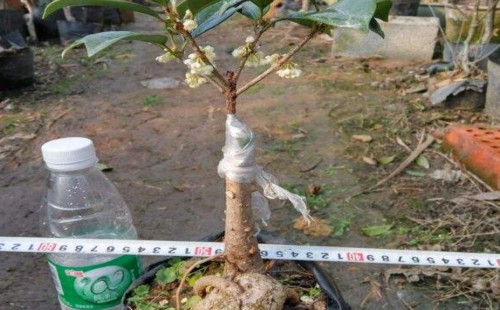
Chinese fringetree has low requirements for potting soil, because its ability to adapt to the environment is extremely strong; whether in neutral, acidic or slightly alkaline soil environments, it can usually grow very well. Moreover, when Chinese fringetree is used to graft osmanthus, the compatibility is very strong, and the sprouting and growth results are good. Especially when using an old Chinese fringetree stump to cultivate osmanthus bonsai, it can be placed in the home and is very exquisite and elegant.
Moreover, when using Chinese fringetree as a rootstock to graft osmanthus, a variety of grafting methods can be used. For example, cut grafting, side grafting, cleft grafting, bark grafting, approach grafting and so on are all relatively suitable. We only need to choose a method we are familiar with for grafting. As for how to care for osmanthus grafted onto Chinese fringetree, the care and management methods are actually similar to those for ordinary potted osmanthus, only because osmanthus grafted onto Chinese fringetree often has better growth, so just pay more attention to water and fertilizer management and do a good job in pest and disease prevention and control.
1. Osmanthus relatively prefers light, and osmanthus grafted onto Chinese fringetree is the same. So it needs to be provided with sufficient light; during the flower bud formation period, providing about 10 hours of light time is enough. This can not only promote flower bud differentiation, but also increase the flowering rate of osmanthus.
2. Osmanthus has relatively poor cold resistance, and even osmanthus grafted onto Chinese fringetree is the same, so in winter, heat preservation and cold protection measures must be taken. If the temperature drops to 4°C, the plant should be promptly bagged to protect it from the cold. Because once potted osmanthus is frozen, it is prone to leaf drop, and it also easily affects the later flowering effect.
3. Osmanthus relatively prefers a clean air environment, so it should usually be placed in a well-ventilated and pollution-free environment. Otherwise, the plant will show poor growth, especially the phenomenon of smaller leaves and easy shedding, and may even lead to long-term failure to bloom.
4. In summer, because of high temperatures, osmanthus has a large amount of water evaporation from branches and leaves, so watering needs to be increased in a timely manner; original usually water once a day in the morning or evening. Normally, the potting soil should be kept moist often, but during the flowering period, watering should be controlled, otherwise it will cause a large amount of flower drop. Of course, in addition to not watering excessively, attention should also be paid to drainage and waterlogging prevention during the rainy season. In winter, when the temperature is relatively low, in addition to watering thoroughly once before the beginning of winter, afterward it can be replenished about once every 10 days or so, and the water temperature should preferably be close to or consistent with room temperature.
5. Osmanthus is a tree species that relatively prefers fertilizer. In order to promote growth and flowering, topdressing should be done in a timely manner. From April to May, fertilize once every half month; from June to July, fertilize once a week; after entering August, fertilize once more. The nutrients that can be used are preferably decomposed cake fertilizer water and poultry manure and urine, though some compound fertilizer can also be used.
6. Osmanthus has strong sprouting ability, and especially well-developed roots; a mature tree can send out new shoots twice a year. In order to make the plant grow with abundant flowers and lush leaves while also having a beautiful plant shape, scientific pruning and shaping are usually required. Mainly remove overgrown branches, thin and weak branches, excessively dense branches, diseased and pest-damaged branches, etc. This can not only improve the ventilation and light transmission of the potted plant, but also promote growth, improving ornamental value while maintaining a good plant shape.