What to Do When a Philodendron 'Golden Diamond' Gets Root Rot? Causes and Remedies Explained
During its growing season, the Philodendron 'Golden Diamond' has a relatively high water demand. Besides increasing watering appropriately, it also needs frequent misting to maintain air humidity and make the environment more suitable for the growth of the potted plant. But after winter arrives, watering must be strictly controlled, because in the cold winter environment the Philodendron 'Golden Diamond' often enters dormancy and its water demand becomes very low, so watering must be strictly controlled, following the principle of “better dry than wet”, otherwise root rot easily occurs.
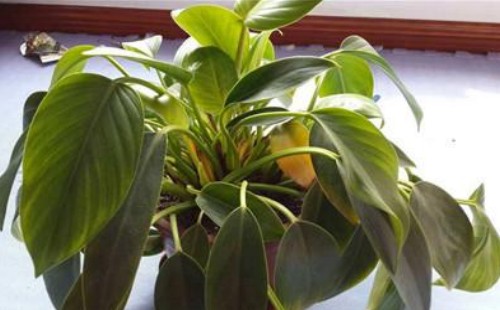
When potted flowering plants develop root rot, their ornamental value is often greatly reduced, or even lost entirely, and root rot is often the most troublesome problem of all. Root rot is mostly caused by uncontrolled watering. When we encounter root rot in a Philodendron 'Golden Diamond', the first thing to consider is whether the potting soil is too wet or waterlogged.
The Philodendron 'Golden Diamond' prefers a warm and humid growing environment, but it is often precisely this warm, humid environment that easily causes root suffocation, leading to decay of the plant's root system. In addition, if air circulation is not good enough, the root rot becomes even more pronounced. So what should be done when a potted Philodendron 'Golden Diamond' gets root rot?
Since root rot is mostly caused by excessive watering, we first need to promptly improve ventilation to speed up water evaporation, and at the same time check whether the drainage holes at the bottom of the pot are clogged, making sure they are unobstructed. Of course, the most important thing is to stop watering immediately. If the root rot is not severe enough to be fatal, these measures alone can usually allow the potted Philodendron 'Golden Diamond' to gradually return to normal growth.
But if the root rot is relatively severe, we need to promptly take the plant out of its original pot. Then promptly cut off the old leaves on the lower part of the plant, keeping only a few new leaves on the upper part. At the same time, trim the roots appropriately, especially the damaged and rotted parts, which must be completely cut away. After that, apply a fungicidal and disinfecting agent such as carbendazim to the wounded areas left on the roots. Finally, plant it in clean coarse sand to recover.
When planting the Philodendron 'Golden Diamond' in coarse sand, the depth should be moderate; the part buried in the coarse sand should generally be about 5 cm deep. Then gently firm the sand around the plant with both hands, water thoroughly once, and place the pot in a bright, well-ventilated spot for care, where it can receive indirect light. In particular, direct sunlight must be avoided, because the plant is quite fragile at this time, and strong light not only hinders its recovery but may even kill it.
After planting the damaged Philodendron 'Golden Diamond' in coarse sand, besides avoiding strong light, do not continue watering it. After all, the plant developed root rot because it was waterlogged, and it has already been watered thoroughly once since being planted in the coarse sand, so there is no need to keep watering. If the environment does become too dry during the recovery period, we usually only need to mist it to maintain humidity. With this kind of care and management, the Philodendron 'Golden Diamond' will gradually resume growth; if all goes normally, it can usually be repotted after 1 month.