How to grow a Chijumaru bonsai? A detailed guide to care methods
Chijumaru black pine is a variant of Kotobuki pine; its needles are somewhat shorter than those of Kotobuki pine, yet its shade tolerance and sprouting ability are stronger. It usually looks best when the needles are kept within 25 mm in length, making it very suitable for creating superior bonsai for viewing, with extremely high artistic value. So how do you care for a Chijumaru bonsai?
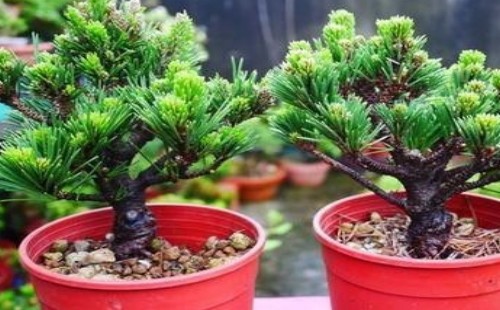
Chijumaru is more expensive than Kotobuki pine, and therefore also more precious. Its needles are dark green and glossy. Since the needles themselves are relatively short and fine, it generally does not need short-needle techniques to grow very neatly and evenly, making it relatively easy to maintain. Today, the editor will share with you the care methods for a Chijumaru bonsai.
I. Watering
The water used for watering Chijumaru should preferably be rainwater or snow water from nature, so you should usually store more of it for later use. If you do not have any, you can make do with river or pond water. If that is not available either, you can also use tap water that has been left standing for several days. During the growing season, watering should be appropriately increased; in early spring, water before noon; in summer, water in the morning and evening; in autumn and winter, water lightly in the afternoon.
II. Fertilizing
Spring and autumn are the seasons when Chijumaru grows most vigorously. To meet its growth needs, original typically requires appropriately increasing topdressing. In summer, because temperatures are relatively high, fertilizing should be reasonably controlled. In winter, because temperatures are too low and the plant is basically in a state of stalled growth or grows very slowly, its nutrient demand is low, so fertilizing is generally not needed.
III. Pruning
Pruning of a Chijumaru bonsai should preferably be done in early spring before new buds sprout. It mainly involves thinning branches and leaves and shortening overly long branches so that their proportions remain consistent with the other branches. Through pruning, the bonsai can maintain a more beautiful shape while also improving its ornamental effect.
IV. Turning the pot
Chijumaru has a fairly obvious tendency to face the sun, so the pot needs to be turned from time to time so that all sides can fully receive light, allowing the branches and leaves on all sides to grow more evenly and avoiding uneven growth in some areas due to too little light. Especially during the growing season, the flower pot should be rotated 180 degrees once every week.