What are the care methods to thicken bonsai trees
For bonsai creators, in pursuit of the highest ornamental value and artistic effect, they will often try every possible means and do everything they can to make bonsai trees grow better and have more beautiful shapes. Among these, thickening the branches and trunks of bonsai trees is relatively common. Obviously, for many bonsai trees, the branches and trunks become more ornamental after thickening. So, how can bonsai trees be made thicker?
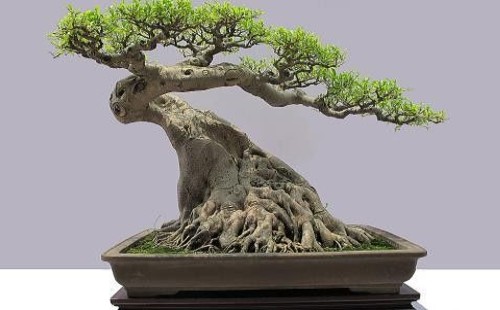
In order to make the branches and trunks of bonsai trees thicken quickly, shorten the time needed to take shape, and let their beautiful forms suitable for appreciation appear sooner, it is usually necessary to cultivate them from the following aspects:
1. Accelerate growth
Usually, only when the growth rate of bonsai trees is accelerated can the time for the branches and trunks to thicken be shortened. The growth process of bonsai trees is actually a process of accumulating nutrients. To accelerate the growth of bonsai trees, this is usually achieved by supplementing nutrients and increasing nutrient supply.
Usually, applying nitrogen, phosphorus, and potassium fertilizer to trees can promote tree growth to a certain extent. As long as the ratio of these three elements is scientific and reasonable, poor growth generally will not occur. At the same time, we also need to appropriately increase light. If the temperature is relatively stable, we can also increase the solubility of carbon dioxide, because this can effectively promote photosynthesis, and the trees will also grow quickly.
Of course, what is relatively closely related to this is that by pruning withered and yellow branches and leaves and spent flowers, and promptly thinning flowers and fruit, a large amount of nutrients can also be saved, and at the same time favorable conditions can be created for the rapid growth of trees. It can be seen that nutrients are an important aspect of promoting trees to maintain rapid growth.
2. Pinching and topping
Pinching and topping mainly means promptly removing the growth points at the top of the tree at the appropriate time, because the top of the tree often has a relatively obvious growth advantage. Through pinching and topping, not only can the growth height of the tree be controlled to achieve the purpose of dwarfing, but the path of nutrient transport can also be changed, allowing nutrients to accumulate in large amounts below the terminal branches, thereby achieving the purpose of thickening the tree's branches and trunks.
Of course, if we want to locally thicken the upper branches and trunks of a bonsai tree, we can use wire to achieve this. Usually, the wire is tied around the base of the branch or trunk, which can prevent nutrients from being transported downward, thereby keeping nutrients in the upper part of the branch or trunk and achieving the purpose of local thickening.
3. Hormone regulation
In addition to increasing nutrients to thicken the branches and trunks of bonsai trees, we can also stimulate plant growth by applying plant growth hormones. Commonly used plant hormones include chlormequat, paclobutrazol, trunk-thickening liquid, etc. After reasonable application, they can not only inhibit the growth height of trees, but also achieve the purpose of thickening branches and trunks.
4. Local wounding
Local wounding of trees is an important means of promoting the thickening of bonsai trees. It mainly promotes the differentiation of the tree's cambium through artificial wounding, thereby making the branches and trunks thicker. After a tree is injured, the cambium will accelerate differentiation to quickly heal the wound. This process of branch and trunk thickening is actually the process in which the cambium of the branch or trunk differentiates to form phloem and lignify. Therefore, we often see that after a tree is injured, over time a relatively large burl forms at the wound site, similar to the scar formed after a human injury.
5. Binding multiple plants together
Sometimes, we plant multiple trees in one flowerpot, and to achieve a thickening effect, we can tightly bind multiple trees together and let them grow pressed closely against each other. After a period of time, we then peel off the bark from the parts where the trees are pressed closely together, and then continue to bind them together. Over time, the multiple trees will grow tightly together, like one thicker tree. The principle of thickening trees in this way is similar to grafting.