How do you care for a Kalanchoe so it bursts with blooms? These care tips you need to master
Kalanchoe (Kalanchoe blossfeldiana) not only blooms beautifully and is suited to pot culture for its flowers, its leaves are also very attractive, so it works well as a foliage plant too. What's more, the kalanchoe's flowering period is relatively long, often lasting from December of the previous year to April of the following year. Compared with many flowering plants, a 4-month flowering period may not count as ultra-long, but compared with ordinary flowering plants, it still counts as fairly long.
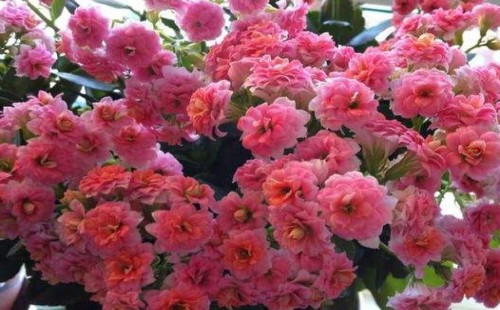
Since both the flowers and leaves of the kalanchoe are worth admiring and it is suitable for growing in pots, if you can get it to burst with blooms, it will naturally look even more beautiful and will surely be the icing on the cake. So how do you care for a kalanchoe so it bursts with blooms?
1. Soil
Kalanchoe prefers a soft, airy, well-draining potting soil environment. You can use leaf mold, garden soil and sandy soil mixed in a certain ratio to make a growing medium. If you feel the permeability is still not strong enough, we can also add an appropriate amount of perlite, along with some compound fertilizer as a base fertilizer. In this way, the potting soil is not only well-draining but also fairly fertile, making it more suitable for the growth of potted kalanchoe.
2. Light
Kalanchoe prefers light, so whether in the growing season or the flowering period, it should be given sufficient light conditions. If there is not enough light during the growing season, it cannot carry out photosynthesis normally and cannot provide for the plant's normal growth activities; it may also lead to no flowering, few flowers and leaf drop, seriously reducing its ornamental value. But in summer, avoid harsh sun exposure, otherwise the plant may get sunburned.
3. Temperature
As long as the ambient temperature can be kept between 15°C-30°C, the plant's growth is usually unaffected by temperature. In summer, provide appropriate shade and mist more water to cool down and retain moisture; in winter, regulate the temperature well. Usually the ambient temperature needs to stay above 10°C for it to overwinter safely, while ensuring it can flower smoothly in December. So in winter, it is usually best to place the pot indoors near a windowsill in a ventilated, sunny spot for care.
4. Watering
In spring and autumn, since the temperature is relatively mild, watering potted kalanchoe usually needs to wait until the soil has dried out, and it is enough to keep the potting soil in a moist state, so watering should not be excessive; under high summer temperatures the plant easily enters a semi-dormant state, so watering should be controlled to avoid a hot, humid environment, while strengthening ventilation and misting more water to retain moisture; in winter, before flowering, water thoroughly to support blooming. Usually wait until the soil 3-5 cm below the soil surface has dried before watering, and pay attention to the soil's permeability. If there is slight compaction, loosen the soil in time; if the permeability is too poor, repot and change the soil in time.
4. Fertilizing
The focus of fertilizing kalanchoe is to promote bud formation and flowering. Normally, you can maintain a monthly application of 1-2 times of dilute, well-rotted organic liquid fertilizer; during high summer temperatures, kalanchoe easily enters a semi-dormant state, so stop fertilizing in time; in autumn and winter, before flowering, increase topdressing, which can promote the formation and differentiation of flower buds and ensure there are enough nutrients to support blooming during the flowering period, mostly with phosphorus and potassium fertilizers.
5. Pinching
When a potted young kalanchoe plant grows to a certain height, pinch it back reasonably according to the plant's growth condition, to prevent leggy growth that affects bud formation and causes no flowering or few flowers. So pinching should start from the young plant stage, and multiple pinchings are needed during this period to encourage more branches to sprout, especially more flowering branches, so as to ensure the plant grows luxuriantly while still flowering normally.
6. Pruning
When the flowering period of the potted kalanchoe ends, we should prune it in time, mainly by cutting off spent flowers and withered yellow old leaves, to prevent them from needlessly consuming nutrients, affecting the plant's recovery of vigor and thereby affecting the next round of flowering.
After the flowers on the branches have finished blooming, besides cutting off the spent flowers, you also need to cut off the first pair of small leaves on the flowering branch and keep the second pair of small leaves, as this is more conducive to sending out new flowering branches. After the newly sprouted tender branches and leaves are topped and defoliated, more flowering branches can form, thus achieving a second round of flowering.
Of course, if you want to prompt the potted kalanchoe to bloom a second time on schedule, we also need to regulate the temperature in the plant's growing environment, and combine repotting, pruning, water and fertilizer and other aspects of care in a multi-pronged approach. By then, we will not only welcome a second flowering, but also reap the joy brought by it bursting with blooms once again.