How do you prune and water-propagate pennywort? Let me teach you the correct method
Pennywort (Hydrocotyle vulgaris) has tenacious vitality and can be grown either in soil or in water. As long as it is well cared for and managed, it can successfully produce small flowers. If grown in water, the round leaves on the water's surface look like miniature lotus leaves, in no way diminishing its ornamental appeal. So how do you prune and water-propagate pennywort?
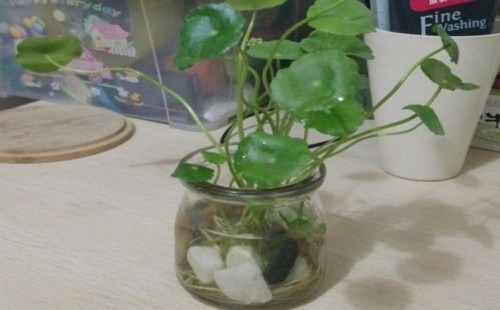
If growing it in water, the cuttings must have roots when pruned, otherwise they will be very difficult to keep alive. To improve the ornamental quality of water-grown pennywort, we can prune it appropriately to control the position of the leaves, then submerge the lower end of the rooted stems and branches in water and grow them in a container.
To prevent the rhizomes from floating up in the water due to buoyancy, we can find some pretty small stones and place them at the bottom of the container to anchor the pennywort's rhizomes to the bottom. There are many kinds of stones; if you value aesthetics, you can buy some colored stones and put them at the bottom of the container.
At the same time, to ensure the pennywort maintains good growth, each time you change the water you can add a few drops of nutrient solution specially made for water-grown flowering plants, so the pennywort can obtain more nutrients from the water and thus grow better. Of course, you can also skip the nutrient solution; we can instead put a layer of a mixture of sand and nutrient soil at the bottom of the container, then weigh it down with stones.
Of course, we can also grow pennywort using only fine sand and clean water, skipping even the stones. Originally, growing a few pennywort plants of varying heights in it looks very attractive even as they grow, giving a feeling of "emerging from the mud unsoiled," standing proud in the world.
But note that for water-grown pennywort, if the entire plant is submerged below the water's surface, you must change the water frequently, and when changing the water after a few days, let the plant receive sufficient light, otherwise the pennywort is prone to rotting stems and leaves. Also, when changing the water, do it gently and add water gradually, otherwise the container easily becomes cloudy, which not only soils the pennywort's stems and leaves but also spoils the container's appearance.