How to grow coleus? Detailed guide to cultivation methods
Coleus leaves are brilliantly colorful, which gives them a wide range of uses. People can not only plant them together with other flowers and plants to enhance the ornamental effect, but also grow them alone as potted plants, and their ornamental value is equally excellent. When grown as a household potted plant, it is usually placed in the living room, study, and similar places, and it often brings a great deal of liveliness to the environment.
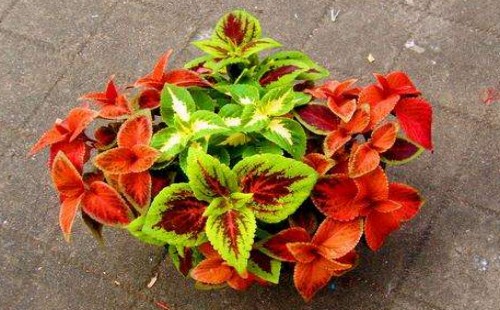
Placing potted coleus in the home has a very distinctive effect on beautifying the home environment. If you do not believe it, why not try growing a few pots at home. However, only by growing potted coleus well can you achieve a good decorative effect. So, how do you grow coleus? Below, the editor will share with you the cultivation methods for potted coleus.
1. Soil
If growing coleus in a pot, the potting soil is required to be rich in humus, and the soil must be fertile, loose, and excellent in both air permeability and water permeability, with sandy loam being the ideal soil type. Cultivating in such a soil environment creates good physical conditions for the growth of coleus.
2. Light
Coleus is not tolerant of direct strong light, but rather prefers ample soft light, because when the light intensity is suitable, the more sufficient the light, the more vivid the leaf color. Under the scorching sun in summer, exposure should be avoided, otherwise the leaves of coleus may become rough and lose their luster; but in an environment with frequent insufficient light, the leaf color is also unlikely to become vivid.
3. Temperature
The temperature in the growing environment of coleus is also very important, and the most suitable growing temperature is between 20°C-30°C. When the temperature exceeds this range, the leaf color will deteriorate, which is often quite fatal for a foliage plant. In winter, it should be placed indoors for care, generally keeping the room temperature between 20℃-25℃, and the minimum temperature should also be kept above 10℃. This is because when the temperature is too low, not only will the leaf color deteriorate, but yellowing and leaf drop may also occur. And when the temperature drops below 5℃, it is prone to freezing and dying.
4. Watering
Coleus has certain requirements for the humidity of its growing environment, so watering should be timely in normal times to ensure the potting soil can often remain moist and will not suffer from a lack of water due to insufficient watering. However, coleus is neither drought-tolerant nor waterlogging-tolerant, so before and after watering, attention should be paid to whether the humidity in the potting soil is appropriate. When the growing environment of coleus becomes short of water, the leaves are prone to losing color due to dehydration, and the root system is also susceptible to soft rot.
5. Fertilizing
Although coleus likes a fertile soil environment, it does not depend heavily on fertilizer, and additional fertilizing also needs to be determined according to the plant's growth condition. Generally, during the growing season, a nitrogen-based fertilizer can be applied 1-2 times per month, because coleus is a foliage plant, and properly applying nitrogen fertilizer can promote more lush leaf growth, more vivid leaf color, and higher ornamental value.
6. Pruning
Coleus is suitable for foliage viewing, so we should let it display its beautiful branches and leaves as much as possible. To encourage the plant to produce more branches and leaves, multiple pinching treatments are usually carried out starting from the seedling stage, so that not only are the branches and leaves more lush, but the plant shape is also fuller. After flowering, aside from retaining 2-3 nodes on the lower branches, the rest should be cut off in time to stimulate the plant to sprout more new branches and leaves, keeping the potted plant attractive at all times.
7. Pests and diseases
Coleus is prone to damping-off disease at the seedling stage, so soil disinfection and sterilization should be done well before planting. During the growing period, however, it is susceptible to leaf spot disease, which can be treated by spraying thiophanate mixed with water; when grown as an indoor potted plant, in a hot, humid, and poorly ventilated environment, it is susceptible to attacks by pests such as scale insects, red spider mites, and whiteflies, which can usually be killed by spraying omethoate mixed with water.