What to Do When a Black Persimmon (Black Bone Tea) Bonsai Drops Its Leaves? Causes and Solutions
Black Bone Tea (black persimmon) is a high-quality material for stump bonsai, and its ornamental value is extremely high. At the same time, the plant also has a certain tolerance to shade, drought, and poor soil, so it is very suitable for placement on a balcony or even for care and management indoors. However, many bonsai enthusiasts have found during care and management that Black Bone Tea keeps dropping its leaves. What is going on?
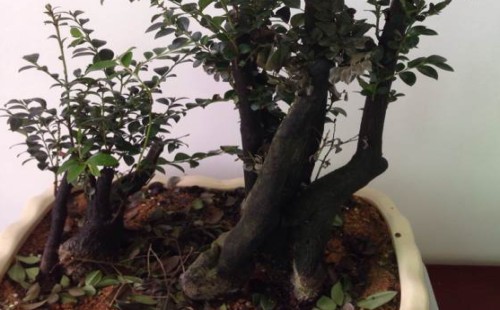
Black Bone Tea is a bonsai tree species with extremely strong ornamental value, but once leaf drop occurs, its ornamental value is inevitably greatly reduced. So, what should be done when Black Bone Tea drops its leaves? To solve the problem of Black Bone Tea dropping its leaves, we first need to investigate from the aspects of its growth habits, care environment, and management methods.
Black Bone Tea, also called black ebony, originated in tropical rainforests. Because it grows for a very long time and also grows very slowly, mature old stumps are very precious, and they are almost impossible to find in the wild. The Black Bone Tea currently appearing on the market basically belongs to artificially propagated varieties. This tree has fine texture, very high density, and very strong hardness, so it is a precious tree species.
At the same time, Black Bone Tea has relatively poor water tolerance. In addition to needing increased watering during the growing season, after it has taken shape it should be watered appropriately sparingly. Its air humidity requirement is generally around 70% as suitable; at the same time, the most suitable growth temperature for Black Bone Tea is above 20°C, and even if the minimum temperature is kept at 3°C-4°C, frost damage will not occur. Therefore, as long as such humidity and temperature conditions are maintained throughout the four seasons, normal growth can generally be maintained.
Although Black Bone Tea does not have high requirements for potting soil, it is not true that any soil is suitable for its growth. If plain sand is used directly to grow it, it often causes poor growth and leaf drop. This is because plain sand has a very low content of nutrient elements, lacks the trace elements needed for plant growth, cannot provide a suitable pH value, and also increases the chance of breeding pathogens.
Therefore, in preparing the potting soil for growing Black Bone Tea, in addition to using a high proportion of sand, the soil quality should also be fertile, loose, and acidic. Generally, loess or red soil is used, and then some coarse sand, vermiculite, coconut coir, perlite, etc. are mixed in to improve the looseness and permeability of the potting soil, while a small amount of organic fertilizer is also applied as a base fertilizer. In this way, the requirements of the Black Bone Tea bonsai for potting soil can be met, so leaf drop caused by improper soil use will not occur.
Of course, Black Bone Tea dropping its leaves may also be caused by an improper placement location. Although Black Bone Tea has a certain shade tolerance, after all, as a plant it needs to receive light for photosynthesis so as to promote growth. If it is placed indoors for a long time for care, it will inevitably cause a lack of light, so it may drop its leaves. The recommended practice is still to place the bonsai near a windowsill or on a balcony, which not only ensures smooth ventilation but also makes it easy to receive light to meet the needs of photosynthesis.
In addition, if the potting soil remains moist for a long time, especially when the temperature is high and there is no ventilation, it is not only easy to breed pests and diseases, but may also lead to root rot. However, whether it is attacked by pests and diseases or root rot occurs, both may cause leaf drop. Therefore, the usual care environment needs to ensure smooth ventilation and sufficient light. In particular, watering should not be excessive; for mature trees, it is generally suitable to keep the potting soil on the dry side.
In summary, the main causes of Black Bone Tea dropping its leaves are unsuitable potting soil, lack of light, excessive watering, infection by pests and diseases, and poor ventilation conditions, among others. To improve this poor growth condition of Black Bone Tea, we need to focus on these aspects. It is believed that the leaf drop will soon be improved.