Reasons and solutions for dry, falling leaves on Buddhist pine (Podocarpus macrophyllus)
Buddhist pine bonsai is highly ornamental thanks to its graceful shape and evergreen leaves all year round, and people today always like to add a bit of greenery to their homes, so for a green plant like the Buddhist pine that is both ornamental and brings greenery while also carrying an auspicious meaning, it is often a good choice. However, sometimes our care and management work may not be done properly, causing the Buddhist pine to show poor growth such as withered leaves and leaf drop. This will inevitably reduce the ornamental value of the Buddhist pine, and it may even become very unsightly. So, what should you do when the Buddhist pine's leaves dry up and fall off?
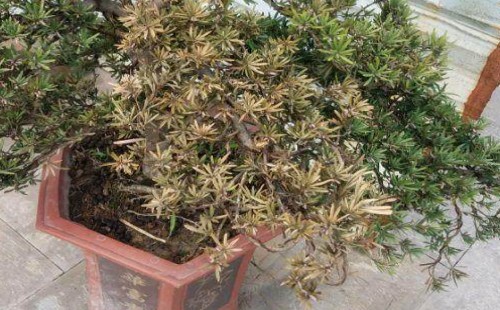
For a tree species like the Buddhist pine, which has an extremely long lifespan and stays green all year round, once poor growth such as dry, falling leaves occurs, there must be a reason for it. Only by finding the real cause can we take further remedial measures. And to find the cause, we usually need to start by understanding its growth habits, then check according to those habit characteristics whether the care environment is inappropriate and whether the management methods are scientific, and analyse further; only in this way can we trace the cause, apply the correct remedial measures, and recover the losses as early as possible.
Combining the characteristics of the Buddhist pine's growth habits with the application of care and management methods, practice has proved that the phenomenon of withered leaves and leaf drop in Buddhist pine mainly comes from the following aspects:
1. Insufficient light
Because the Buddhist pine looks good and also carries the auspicious meaning of attracting wealth and treasure when placed at home, many bonsai enthusiasts keep it indoors for the long term. And sometimes they may neglect management and leave it indoors for a long time, resulting in insufficient light, so the plant cannot carry out photosynthesis. But the Buddhist pine quite likes light, and in a shaded environment without light for a long time, it will often gradually show dry leaves and leaf drop.
So, for this situation, first we need to promptly provide it with suitable light; it is best to move it outdoors for a period of care, and after the plant returns to normal growth, move it indoors for a period, then move it outdoors again. Only by alternating in this way can the plant often be kept safe and sound. Of course, if there is a windowsill indoors that can fully receive light, it is recommended to place it on the windowsill, which avoids the awkwardness and trouble of moving it frequently.
But note that in the high-temperature, strong-light environment of summer, you need to take timely shading measures to avoid scorching from direct sun, and generally place it in a semi-shaded spot for care. At the same time, humidity control also needs to be done well: besides increasing watering, you also need to spray water more to maintain air humidity, and you also need to ensure the environment is ventilated to avoid pests and diseases. When the temperature drops in autumn and winter, you also need to take timely measures to keep it warm and protect it from the cold, so the plant is not frostbitten.
2. Lack of nutrients
Withered leaves and leaf drop in Buddhist pine is a relatively serious phenomenon, because once its leaves are completely withered and yellow, the Buddhist pine will soon die as well. This is because the plant cannot grow new leaves and cannot breathe through its leaves, and a plant in an oxygen-deficient state is very dangerous. An important cause of this phenomenon is the lack of nutrients in the pot; when the plant is in this nutrient-deficient condition for a long time, it is very hard for it to maintain growth, and over time it ends up like this.
So, in the daily care and management process, besides watering scientifically, you also need to apply topdressing appropriately to supplement nutrients. Generally, apply organic fertiliser with a high nitrogen content; after all, the Buddhist pine is grown for its foliage and needs the plant to produce a lot of green, and nitrogen fertiliser often plays this role. Of course, you can also appropriately apply some phosphorus and potassium fertiliser. Usually, thin alum fertiliser water, compound fertiliser, and cake fertiliser water are more suitable.
3. Infection by disease
Another important cause of poor growth such as withered leaves and leaf drop in Buddhist pine is infection by leaf blight. This disease is often highly destructive, covers a wide area, and is quite stubborn; once infected, if not controlled and eliminated in time, it will spread quickly and cause great harm to the plant. Usually this disease is caused by factors such as planting too densely, poor ventilation, neglected management, and sunscald from strong sun. It generally occurs more easily in summer and autumn.
When the plant is infected with this disease, we should promptly prune off the infected branches and leaves and destroy them in a concentrated way in time; at the same time, we should strengthen daily management, and by improving care conditions, reduce the disease and improve the plant's disease resistance. If it is in the early stage of the disease, you can use fungicides such as amobam, chlorothalonil, and Bordeaux mixture to spray and control it.