Reasons for Yellowing Leaves of Podocarpus macrophyllus and Solutions
Podocarpus macrophyllus is a tree species that can remain evergreen all year round, and it is also an excellent material for making bonsai. Because it grows relatively rarely in the wild and is also quite difficult to propagate, it was once listed as a rare tree species in the national protected tree species directory. At the same time, precisely because the leaves of Podocarpus macrophyllus remain emerald green all year round, it is widely used in landscaping, and when made into bonsai, the green leaves are also a very important ornamental part.
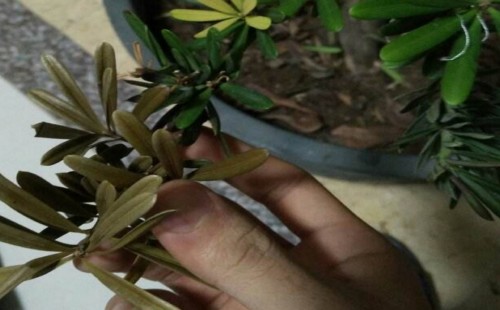
However, in daily maintenance and management, it is unavoidable to encounter the phenomenon of yellow leaves on Podocarpus macrophyllus. So, what is going on with yellow leaves on Podocarpus macrophyllus? If we encounter yellowing leaves on Podocarpus macrophyllus, what should we do? First of all, if Podocarpus macrophyllus shows yellow leaves, it will inevitably greatly reduce its landscaping effect, and as a bonsai, it often causes its ornamental value to be almost completely lost, which is also what we least want to see. To figure out what is going on, we still need to read on.
According to experience from growing other green plants, yellow leaves on a plant are mainly caused by factors such as an unsuitable growing environment, improper water and fertilizer management, and attacks by pests and diseases. As a green plant, Podocarpus macrophyllus can likewise also be affected by these factors, except that we need to combine them with its growth habit characteristics to make a judgment and handle them promptly, so as to reduce losses as much as possible and allow the plant to successfully have its symptoms eliminated.
1. Unsuitable temperature
Everyone knows that Podocarpus macrophyllus is not cold-tolerant. When the temperature is too low, it not only easily enters dormancy, but may even suffer frost damage. In fact, Podocarpus macrophyllus is also relatively afraid of high temperatures, especially in an environment with high temperature and low air humidity, where yellowing leaves are relatively likely to appear. In addition, if the environment is poorly ventilated, it may even trigger pests and diseases!
Based on the above reasons, it is recommended to place Podocarpus macrophyllus in summer in an environment with relatively lower temperature and smooth ventilation for maintenance, while avoiding prolonged exposure to scorching sun. Of course, if the air humidity is relatively low, it is necessary to spray water into the air in time, or spray more water on the plant, the ground, and the space, to avoid the appearance of a high-temperature and dry air environment. In this way, the phenomenon of yellow leaves caused by an unsuitable growing environment can be well avoided.
2. Improper watering
Although Podocarpus macrophyllus has certain requirements for humidity in its growing environment and generally prefers moisture, it should not be watered blindly during the process of replenishing water. In particular, when watering, it should be timely but not excessive. This is because Podocarpus macrophyllus may show yellowing leaves in a growing environment that is too dry or too wet or even waterlogged.
To change this situation, when the potting soil becomes dry, water it in time, and when the air humidity is too low, spray more water, especially in a high-temperature and hot summer environment. But watering Podocarpus macrophyllus also requires good control of frequency, and each time it needs to be watered thoroughly, and the drainage effect in the pot should also be good, ensuring that when there is excess water, it can be discharged out of the pot in time. Once Podocarpus macrophyllus shows yellow leaves, first check the dryness and wetness of the potting soil, and even consider whether the relative air humidity is suitable, and then take corresponding handling measures.
3. Insufficient nutrients
In addition to preferring moisture, Podocarpus macrophyllus also relatively prefers fertilizer. If it remains in a state of insufficient nutrients for a long time, it may cause the plant to show yellowing leaves. Especially during the growing season, although Podocarpus macrophyllus grown as a potted plant grows slowly, it still needs the soil to have a certain fertility. After all, the space in a flower pot is limited, and the nutrient content is also relatively limited. To allow Podocarpus macrophyllus to maintain growth for a long time, timely topdressing is also very important.
Generally, sufficient base fertilizer is applied when potting, and topdressing is done well later. Once yellow leaves appear on Podocarpus macrophyllus due to lack of nutrients, we generally need to improve it by adding an appropriate amount of nitrogen fertilizer, but often with the principle of "light fertilizer applied frequently." An appropriate amount of ferrous sulfate can also be added, then composted into alum fertilizer water for application. During the growing season, topdressing can be maintained once every 1-2 months, generally combined with watering. For potted and bonsai Podocarpus macrophyllus, some low-concentration compound fertilizer water or cake fertilizer water can also be sprayed as foliar fertilizer.
4. Attacks by pests and diseases
In addition to the above three situations, if Podocarpus macrophyllus is attacked by pests and diseases, yellow leaves may also appear due to damage to the tree body. Podocarpus macrophyllus is relatively prone to infection by root rot, leaf spot disease, and the like in a high-temperature, humid, and poorly ventilated environment. Once attacked by these diseases, yellow leaves are relatively likely to appear. Of course, if there are boring insect pests, they may also harm the branches or even the main trunk, and yellow leaves will likewise appear.
Therefore, in the daily maintenance and management of Podocarpus macrophyllus, in addition to creating a suitable growing environment for it, it is also necessary to do a good job in the prevention and control of pests and diseases. For cases of infection by diseases, we need to promptly prune these affected leaves and destroy them centrally, and we also need to use drugs such as chlorothalonil and propiconazole once a week to spray and kill them. Generally, alternating use several times in succession can cure it. At the same time, the yellow leaf phenomenon will gradually be eliminated.