Reasons for Curled and Withered Leaves on Red Maple Bonsai and How to Fix Them
In modern horticultural applications, as people widely accept colorful landscaping effects, colorful green plants are also increasingly favored by gardening enthusiasts. Moreover, people are paying more and more attention to the high degree of integration of color and nature in green ecological environments. Red maple (Acer) is widely used in public places because of its brilliant red color in autumn and its neat crown. The American red maple (Acer rubrum) in particular is even more striking, and is one of the treasured colorful tree species for greening and beautifying urban environments in recent years.
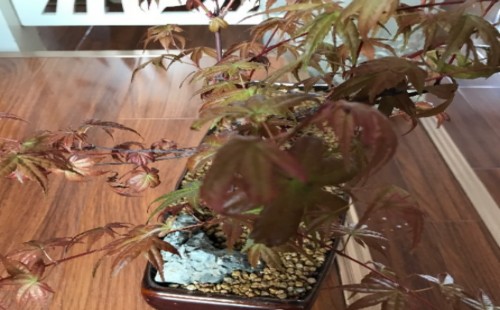
Red maple is a small deciduous tree suited to growing in warm and humid climates. It is drought-tolerant, cold-tolerant, averse to strong light, and afraid of waterlogging. It is best grown in fertile, loose soil with good aeration and drainage. As long as you follow its habitual characteristics, provide a suitable growing environment, and carry out good care and management, it is generally quite easy to keep it alive and thriving.
Of course, if our routine care and management are not up to standard, red maple can still develop poor growth. Recently, a gardening friend reported that their red maple bonsai had developed curled and withered leaves. In fact, this is a fairly common poor-growth phenomenon encountered by red maple bonsai enthusiasts when growing red maples. So what should be done when red maple bonsai leaves curl and wither?
Practice has shown that curled and withered leaves on red maple are mainly caused by poor light conditions and poor watering practices. When it comes to light and watering problems, the usual causes are either lack of light or overly strong light, or long-term water shortage or overwatering, all of which lead to poor growth in red maple. For these aspects, we can rule them out by reviewing the sunlight and watering conditions, then take corresponding measures promptly.
1. Improper Light
Red maple prefers light. Under normal circumstances, we need to provide it with sufficient light so that it can meet its photosynthesis needs. If it stays in a shaded, light-deficient state for a long time, the plant will show curled and withered leaves. But if the light is too strong, especially exposure to the scorching sun in midsummer, this phenomenon can also be triggered. It is clear that whether light is scientific and reasonable has an important effect on the normal growth of red maple.
If red maple is placed indoors in a relatively shaded, light-deficient environment for a long time and develops curled and withered leaves, then improve the light conditions promptly by moving it to a balcony or another spot where it can receive sufficient light for care. But red maple leaves are averse to strong light. If curled and withered leaves are caused by prolonged exposure to strong summer sunlight, take shading measures promptly: you can place it under tree shade, or in a shaded spot on a balcony, or even move it indoors near a windowsill.
2. Improper Watering
Although red maple is fairly drought-tolerant, that does not mean it can go without watering for a long time. If the plant is in a state of water deficiency for a long time, curled and withered leaves will also appear. So water promptly and reasonably, generally watering as soon as the potting soil dries out. Scientific watering measures can provide a certain guarantee for its normal growth, so that growth is not affected by water shortage.
At the same time, red maple is also afraid of waterlogging. If you overwater or fail to take necessary rain protection measures during the rainy season, the potting soil often stays too wet for a long time, or even becomes waterlogged. In such cases, the normal respiration of the red maple root system is often affected, leading to oxygen deprivation, root rot and decay, and consequently curled and withered leaves. So in addition to reasonable routine watering, you should also do a good job of rain protection and waterlogging prevention. Once water accumulates in the pot, drain the excess water promptly and improve ventilation. If the waterlogging lasts too long and damages the roots too severely, it is advisable to dig the plant out, trim and disinfect the roots, and replant it in a new pot with new soil.