Does a Chinese elm bonsai need to be moved back indoors for the summer?
We have now entered midsummer, and people are suffocating under the recent high temperatures and heavy rain. It is not just people; even the Chinese elm bonsai on the balcony is having a miserable time. The main problem is either the scorching sun or the pouring rain, so not only can people not stand this kind of weather, but even the Chinese elm bonsai is struggling in agony. So, does a Chinese elm bonsai need to be moved back indoors for the summer?
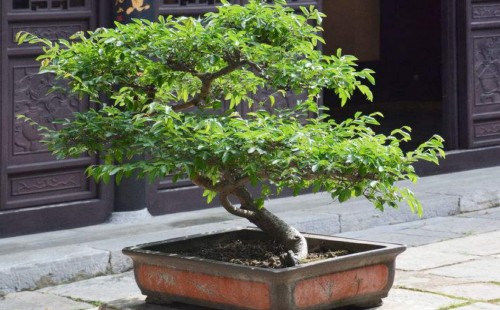
In fact, for a Chinese elm bonsai in midsummer, if it is sometimes exposed to the scorching sun and sometimes to pouring rain, we should avoid this as much as possible and take appropriate protective measures. Although the Chinese elm bonsai is relatively drought-tolerant and likes light, after all, the baking of the summer sun makes it very hard to endure. It is precisely because of the strong light, high temperatures, and the dense branches and leaves of the Chinese elm that the amount of water evaporation is quite large. Even with watering, it is often difficult to achieve a balance with evaporation, so it is very unfavorable to the growth of the Chinese elm. Taking timely and appropriate shading measures is very necessary.
However, the sudden violent wind and rain are also a kind of torment for the Chinese elm bonsai. Original Although the Chinese elm has a well-developed root system and has a certain ability to withstand violent winds, after all, it is grown as a potted plant, so its growth is not as stable as when planted in the ground, and it is prone to tipping over. Moreover, the occasional torrential rain keeps washing over the bonsai, and the pot cannot drain excess water in time, which relatively easily causes root rot. Therefore, whether it is scorching sun or violent wind and rain, it is not suitable to place it outdoors for care, as this carries great risk.
In summer, the Chinese elm bonsai fears scorching sun and violent wind and rain the most, so it needs to be moved indoors in time for care. Moreover, the Chinese elm also has a certain shade tolerance, so placing it in a suitable indoor location for care in the short term is also fine. In this way, it can not only effectively avoid the invasion of scorching sun and rainstorms, but also make care and management more convenient, and it can also add a touch of greenery to the interior, bringing a bit of coolness to the indoor space in summer.
However, after all, the Chinese elm is a tree that likes light, so even if it is moved indoors for care, it is often necessary to choose a suitable location. We can move it to a place indoors near a window, but avoid blocking the window with it, because from the perspective of feng shui, placing a Chinese elm bonsai at the window, although it can ensure smooth ventilation and facilitate lighting, has a certain impact on home feng shui. Therefore, it is better to place it indoors near the windowsill and keep a certain distance from the window.
However, once the weather clears up, we can move it outdoors to a balcony or under the shade of a tree for care. In this case, the main purpose is to make the environment more ventilated and smooth and to facilitate receiving light, avoiding the occurrence of high-temperature, humid, and unventilated conditions, otherwise it will still have a certain impact on the normal growth of the Chinese elm and may even increase the risk of infection by pests and diseases. Therefore, when encountering harsh summer weather conditions, in order to avoid harm to the plant, it is necessary for us to move the Chinese elm bonsai indoors for care and management.