How do you grow the roots of a boxwood bonsai thick? Master these care methods
Boxwood bonsai has features such as a graceful, dancing tree posture, deep emerald leaf color, and ancient, gnarled, twisting roots, so its ornamental value is quite high, and it is deeply favored by the vast number of bonsai enthusiasts. Moreover, the boxwood tree has a well-developed root system. When creating a bonsai, in addition to the most commonly used method of cutting branches to build up the trunk, you can also raise the roots and expose the roots, which makes boxwood bonsai also very suitable for viewing the roots, improving the ornamental value of the bonsai as a whole.
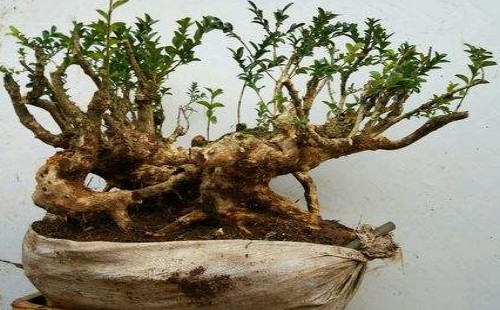
However, root-raising shaping of boxwood cannot be done at any time. First, you need to wait until its root system meets the conditions for shaping. Then you make it into shapes such as large cascading branches, large drooping branches, or even the cliff style. In the process of shaping, the main task is to pull the boxwood's root system to one side. But if it is to be used as a root-exposed bonsai for viewing, we also need to grow the boxwood's roots thick, so that it is more ornamental. So, how do you grow the roots of a boxwood bonsai thick?
Boxwood's root system is often plentiful and well developed, but it is mainly made up of fine roots, making it a typical shallow-rooted tree species. If you dig it out of the pot soil, you will very clearly see a mass of fine roots, with especially many hair roots. To make its root system thicken, and at the same time also make the branches and trunk thicken, topdressing fertilizer to boost growth is usually needed. And in the process of applying chemical fertilizer, using it together with a thickening agent gives a better effect. However, after fertilizing, you need to water promptly, and water frequently, so as to promote the growth of the boxwood's root system and achieve the goal of thickening.
Of course, boxwood's sprouting ability is still relatively strong. After it sprouts new shoots, we can first cut off the front 1-2 nodes, which can not only prevent leggy growth, but also save nutrients, letting the saved nutrients be more concentrated in the roots and the tree body, thereby promoting sprouting and also giving the root system a certain strengthening effect. But to make this effect more obvious, we can also repot once every 2-3 years, and when repotting we can appropriately prune the roots, thereby promoting the sprouting and thickening of new roots.
Of course, in addition to doing a good job in the above aspects of management, we also need to do the routine care and management work well, so that it is more conducive to strengthening the tree, including the thickening of the root system. And when the boxwood's root system becomes thicker and larger, this makes it even easier for us to make a large root-raised bonsai. It is just that growing a large raised-root boxwood is not something that happens overnight; it often requires a very long period of cultivation, and you must not rush for quick results, because haste often makes waste.
But in actual growing and application, we can also adopt a very simple and effective method, which is to carry out high-mound soil cultivation. After planting the boxwood alive in a high mound of soil, each year you must use the method of exposing the roots downward to raise the roots, and this operation is likewise a gradual process. Once enough time has passed, the boxwood tree will also present the scene of large raised roots, and at this point the bonsai, whether in ornamental value or economic value, often doubles.