How to grow rootless orchids? Teach you the correct care method
Rootless orchid seedlings appear mainly due to unscientific watering during the cultivation process, or due to excessive fertilizer application causing fertilizer burn, which leads to hollow roots and root rot. But sometimes, to save costs, we can also try planting rootless seedlings, so how do you grow rootless orchids? How should rootless seedlings be handled when they appear?
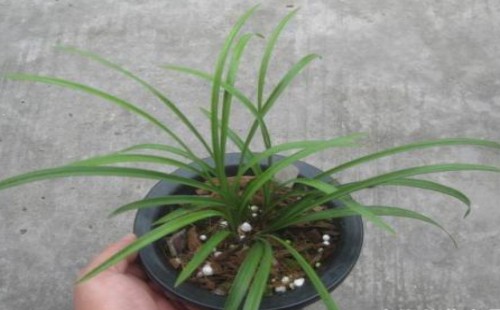
Usually, once discovered, we need to clean them up promptly to avoid infecting other healthy parts. Mainly remove dead branches and rotten leaves, and cut off rotten roots until white tissue is exposed. Then use drugs such as carbendazim for disinfection and sterilization. But for rootless seedling plants, it is best to cut off half of the leaves, keeping the height at about 15 cm, so as to save some nutrients to promote root growth and sprouting.
In this case, the orchid plant's ability to absorb nutrients and water is largely limited, and it mainly depends on the pseudobulb for transport, so it is recommended to cut off part of the leaves of the rootless seedling, otherwise it will affect the sprouting of new roots, and then affect the growth vigor of the orchid seedling. But to bring a rootless orchid seedling back from the brink, we also need to go through the following operations.
I. Potting mix preparation
First, we need to reasonably prepare the potting mix according to the growth needs of the orchid seedling. You can use fine granular potting mix, then mix in 15% rice husk ash and 15% mountain soil. If these substrates are not available, you can use burned coal cinder ash.
However, there are many potting mix formulas. You can also use tree fern fiber, coarse sand, sawdust powder, fine crushed brick particles, and so on. As long as the prepared potting mix is not too strong in fertilizer effect and is loose and breathable, it is fine. But the editor still recommends using rice husk ash, because this potting mix has a very good effect on rootless orchid plants sprouting new roots and sending out new shoots.
II. Potting and planting
The depth and size of the flowerpot used for potting must be appropriate, ensuring that the orchid plant's pseudobulb stays at two-thirds of the pot depth, then cover the pseudobulb with potting mix 0.5-1 cm thick. Potting and planting in this way can ensure a relatively good moisture-retention effect and avoid dehydration of the rootless orchid seedling.
III. Care and management
After potting and planting are completed, the pot should be placed in a cool and ventilated place, avoiding direct sunlight, and allowing it to receive scattered light. If the pot is placed outdoors in a high-temperature environment, it is recommended to set up a shade net for it. Usually pay attention to the dry and wet condition of the potting mix in the pot, and replenish water and maintain moisture in a timely manner. Especially during the rapid growth season of orchids, you must ensure that a certain humidity can be maintained in the pot.
In addition, growth hormone products have a certain promoting effect on root growth and sprouting of rootless orchid seedlings, but they should only be applied at the appropriate time. If the orchid plant is in a dormant state and you apply it, the effect on root growth and sprouting is not very obvious. This is mainly because the environmental temperature is not enough, thereby causing it to remain inactive and unable to grow, and it usually dies during the growth period. However, if at room temperature, it can still be done.
Usually, applying growth hormones to rootless orchid seedlings is suitable during the growth period, because during the growth period the orchid plant's growth factors are full of vitality, absorption is good, and the effects on sprouting and rooting are relatively obvious. It is usually carried out from January to October each year, generally according to the instructions for scientific proportioning, and the rootless seedling can be watered once a week, preferably for 3 consecutive times.
But we can also adopt the method of mixing hormones with water to soak the roots to prompt the rootless seedling to re-root and sprout. Usually soaking for about 30 minutes is enough. At the same time, fixed-pot water can also be used for irrigation, but growth hormones must not be applied at this time, because the rootless seedling does not need nutrients at this stage. What we need to ensure is that it overwinters safely.
Usually, when the new seedling grows to more than 3 cm in height, the new roots and new shoots have basically grown stably, and we can appropriately supplement nutrients for it. Usually, some dilute liquid fertilizer can be applied as a top dressing, such as diluted potassium dihydrogen phosphate solution, cake fertilizer water, etc. Remember that the concentration must be low enough. After that, we can manage the former rootless seedling like an ordinary orchid seedling. Because the previous rootless seedling has now been completely brought to life.