What are the ways to extend the flowering period of azalea bonsai
People all hope to make beautiful things last, which is a pursuit and longing for beautiful things. Just like the azalea, the azalea flower has a beautiful shape and rich colors, and is very suitable for making into bonsai for appreciation, but it is precisely because its blooming is gorgeous and its ornamental value is high that we all hope to obtain a longer flower-viewing time, so extending the flowering period of azalea bonsai is work we need to do well. So, how can we extend the flowering period of azalea bonsai and make the flower-viewing time longer?
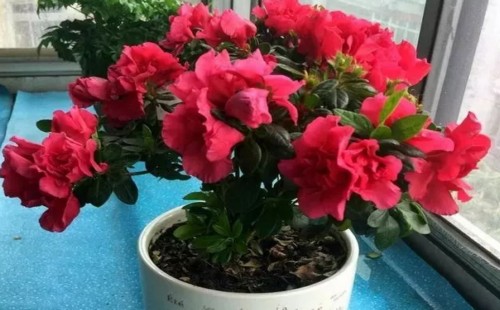
Different flowers and plants have different flowering periods, not only blooming in different seasons, but also with flowering periods of varying lengths. This is not only determined by the characteristics of the flowers and plants, but is also affected by the growing environment. In order to keep azalea bonsai blooming for a long time, we might as well try to achieve this by improving its growing environment and changing maintenance and management methods. To achieve the purpose of extending the flowering period, under normal circumstances, we need to achieve it through management of light and temperature, water and fertilizer, pruning, and other aspects of azalea bonsai.
I. Growing environment
Because azaleas like to grow in a cool and humid environment, we usually need to create such a growing environment for them as much as possible, and the placement position often appears very important. Generally, the position where azalea bonsai is placed must not be exposed to scorching sun, nor lack necessary light; it must not remain in a high-temperature state for a long time, nor lack a minimum temperature guarantee; it is necessary to ensure smooth air circulation, while also preventing raging winds. At the same time, in order to do a good job of moisture retention, it is also necessary to spray leaf water and ground water more often.
II. Potting soil requirements
Azaleas relatively like fertile, loose acidic soil with good air and water permeability, so when mixing soil we can mainly use sandy loam with good permeability, and then mix in some humus. Although azaleas relatively like moisture, they are also afraid of water accumulation, especially in a high-temperature, humid, and poorly ventilated environment, where any water accumulation must be eliminated. Therefore, in addition to scientific watering, the potting soil also needs to have good permeability, so that once too much water is applied, the excess water can be drained away in time. Adding humus to the potting soil can add quite a lot of nutrients to the pot, which is very important for promoting the growth and even the flowering of azaleas.
III. Scientific watering
Azaleas like moisture but are not tolerant of waterlogging, especially in summer, when the temperature is relatively high and the weather is relatively hot, and if poor ventilation is added, it is not only easy to breed pests and diseases, but also very easy to cause root suffocation and root rot. Moreover, the root system of azaleas is relatively fine, without a large number of robust roots, so their water absorption capacity is relatively poor, and watering too much must be avoided. In addition, azaleas are shallow-rooted plants and are generally planted shallowly, and even when watering, they must not be irrigated or washed with a large volume of water, otherwise the root system is easily washed out. Generally, water is supplied by the soaking-pot method or by spraying water. More importantly, in high-temperature summer weather, avoid replenishing water during the time period with the highest temperature of the day, and also pay attention to water temperature, including when watering in winter, so that the water temperature does not form too great a contrast with the outside temperature.
IV. Reasonable fertilizing
Azaleas relatively like a fertile soil environment, but because their root system is too fine and lacks obviously robust roots, fertilizing must not be too aggressive, and the concentration must be well controlled, mainly being dilute. At the same time, avoid applying raw fertilizer, otherwise it is easy to burn the plant's root system, making the roots unable to absorb nutrients normally and affecting the growth of azaleas. But fertilizing also requires grasping the timing, generally applying some organic fertilizer in early spring and late winter. However, because azalea flowers are large and the full flowering period is in summer, it is not suitable to fertilize during the flowering period, and flowering is a matter that consumes relatively much nutrients. Therefore, we can carry out topdressing before and after flowering. Topdressing before flowering is to promote flower bud differentiation and formation and store sufficient nutrients for flowering; topdressing after flowering is because the flowering period consumes a large amount of nutrients and the tree vigor needs to be restored and strengthened through topdressing.
V. Pay attention to pruning
The pruning work of azalea bonsai is generally carried out in spring and autumn, mainly cutting off old, weak, diseased, and disabled branches, overlapping branches, overly dense branches, crossing branches, and other branches that are neither conducive to maintaining the plant shape nor will merely consume nutrients in vain, and it is also necessary to promptly remove residual flowers and shorten flower branches after flowering. Scientifically carrying out pruning treatment can not only keep the azalea bonsai maintaining a beautiful plant shape, but also save nutrients, and furthermore can improve ventilation and light transmission, promote photosynthesis, reduce the occurrence of pests and diseases, and stimulate the plant to better sprout new branches and new leaves. This can not only better promote the growth of azaleas and keep them always in a beautiful ornamental state, but also promote sprouting, especially the production of flower branches, making the number of flowers greater, the quality higher, and the ornamental value of the entire bonsai stronger.