How to grow Caragana so it blooms? Master these care points
Caragana gets its name because its flowers look like golden flying birds, and as a bonsai it has extremely high ornamental value. Its greatest ornamental period is during its blooming season, but the blooming season of Caragana is relatively long, usually lasting from April in spring all the way to November in autumn. As a flowering bonsai, May to June is usually the best period for viewing the flowers. To make the bonsai bloom for enjoyment, daily care and management work cannot be neglected. So, how do you grow Caragana so it blooms?
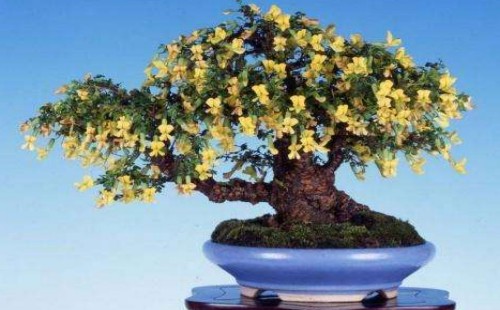
To make a Caragana bonsai bloom smoothly and on schedule, attention must be paid to both its placement and its care and management. But how to place it and how to grow it mainly depends on its growth habits; as long as the care measures are scientific and reasonable, it will bloom smoothly. This is mainly reflected in the following aspects:
1. Placement
Caragana prefers a growing environment with ample light, has the characteristics of being drought-tolerant and cold-tolerant, and also needs to be ensured a smooth ventilation environment. In southern China, since there is no need to worry about the effects of temperature changes, it can generally be placed outdoors for care all year round; but in northern China, if the temperature is too low, it is still recommended to move it indoors or bury the flower pot in the soil for care, to ensure it can overwinter smoothly.
2. Watering
Apart from the period after transplanting into a pot when watering must be strictly controlled while the plant adjusts, at ordinary times you should stick to the principle of "do not water if not dry, water thoroughly if dry", especially during the blooming season, when you should ensure the potting soil has suitable moisture. This not only keeps the plant in good growing condition but also helps extend the blooming season. Of course, in the dry and hot dry season, watering can be combined with spraying water to improve the cooling and moisture-retaining effect.
3. Fertilizing
Compared with many tree species, Caragana can also be considered relatively fond of fertilizer. In addition to using fertile, loose potting soil, appropriate topdressing is also needed to ensure the flowers are more brilliantly colored and the blooming season is longer. Generally, after the plant enters dormancy in winter, one topdressing should be applied, and before the spring blooming season, one application of liquid fertilizer should also be watered on, which can achieve the purpose of extending the blooming season. After blooming, another topdressing can also be applied to promote growth and restore the tree's vigor. However, topdressing should mainly be thin liquid fertilizer, which not only has good fertilizer efficiency but is also well absorbed.
4. Pruning
To make a Caragana bonsai bloom smoothly, pruning work cannot be neglected either. But pruning is not something that can be done anytime and anywhere; it needs to be done in the right season. After the leaves fall in winter, branches that affect the bonsai's modeling effect should be cut off, and starting from spring blooming, branches that have already bloomed should be appropriately shortened, which can prompt the plant to sprout new flowering branches and thus extend the blooming season. In the peak growing season, it is also generally necessary to cut off leggy branches, and at the same time appropriately pinch off the growing tips when the opportunity arises to keep the bonsai in good shape.
5. Repotting
To ensure Caragana maintains good growth and ornamental effect, it is generally repotted once every 2-3 years, but repotting work should preferably be done in early spring, because repotting at that time makes it easier for the plant to adjust. When repotting, it is recommended to remove half of the old soil and then replenish it with fertile, loose new potting soil. But when repotting, it is generally necessary to combine it with root trimming and root raising, which can improve the overall ornamental quality of the bonsai.