How to overwinter Satsuki azalea bonsai? A full analysis of winter care techniques
The ornamental effect of Satsuki azalea bonsai is often directly linked to and influenced by whether the growing environment is suitable and whether the care and management methods are scientific and reasonable. Since Satsuki azalea is a variety of azalea, it retains or inherits many of the habits and characteristics of azaleas, so the care and management work differs only in subtle ways. The biggest difficulty with Satsuki azalea is getting through summer and winter. In a previous article, the editor shared with you an article on how azalea bonsai can safely get through summer; today the editor will discuss with you the question of how azalea bonsai can overwinter.
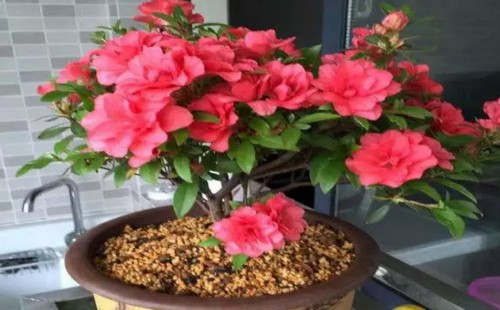
The most suitable growing temperature for Satsuki azalea is maintained between 20°C-28℃, but compared with many flowering plants, Satsuki azalea is much more cold-tolerant in winter. Even so, we still need to control the temperature well under winter care conditions for Satsuki azalea to ensure it can overwinter smoothly. Satsuki azalea is relatively suited to the warm and humid growing environment of southern China; even in winter, the outdoor temperature there is not too low, and since it has a certain cold tolerance, it is also relatively easy to overwinter.
However, to ensure that azalea bonsai is not frostbitten and does not have its normal growth activities affected, it is generally also required that the winter temperature not fall below 5°C, so that it can overwinter smoothly. In the northern regions in winter, care is often much more difficult. After all, winter temperatures in the north are often very low, with outdoor temperatures generally below 5°C, and even low-temperature environments dozens of degrees below zero can occur. Satsuki azalea cannot overwinter smoothly in such an environment, so in northern regions it generally needs to be moved indoors in time before winter arrives.
Then, in northern regions, even if the Satsuki azalea bonsai is moved indoors for care, attention still needs to be paid to management in several aspects to ensure it can overwinter smoothly. The first is temperature control; the temperature is generally required to stay above 5°C, but at the same time it must not be allowed to get too high. Because when the temperature is too high, it will break its dormancy and cause leggy growth; if it is allowed to grow freely, it will inevitably affect the next year's blooming, and may even result in no flowers at all. Therefore, keep the temperature within a reasonable range so that it can both overwinter smoothly and not have its dormancy broken.
At the same time, when placing the Satsuki azalea bonsai indoors for care, since northern regions generally have heating, it is essential to choose the placement location well. In addition to avoiding indoor temperatures that are too high, it is also necessary to avoid placing the bonsai directly in front of a warm-air vent, otherwise the plant is prone to wilting, withering and similar problems. Also, because the air in the north is relatively dry, it is necessary to spray water frequently to maintain humidity, avoiding a situation where the environment is too dry and affects the growth state of the Satsuki azalea.
Moreover, in the northern winter, besides the low temperatures, the low-temperature weather also lasts relatively long. If it is placed indoors for a long time, it will inevitably lack light. Therefore, whenever there is a sunny day, the bonsai should be placed in a sunny spot near the windowsill so it can fully receive light and carry out normal photosynthesis. If the outdoor temperature is suitable at noon, you can move the Satsuki azalea outdoors during the warmest period of the day so it can fully receive sunlight. When the temperature drops, move it back indoors in time for care.
The overwintering problem of Satsuki azalea bonsai has always been a concern for many bonsai enthusiasts. But as long as we can grasp a few key points, overwintering smoothly generally is not very difficult; the main thing is to do well in measures such as keeping warm and guarding against cold, spraying water to maintain humidity, and providing appropriate light. As long as everyone can handle these details well, I believe the Satsuki azalea bonsai can get through the cold winter smoothly.