What to Do When the Roots of a Hydroponic Anthurium Turn Green? Causes and Solutions
Because the anthurium has very high ornamental value, as it can be enjoyed both for its flowers and its leaves, it is deeply loved by people, especially favored by home potted plant enthusiasts. And considering its small impact on environmental hygiene and its relative cleanliness, quite a few plant lovers also like to grow anthuriums hydroponically. However, during hydroponic cultivation, maintenance and care must also be done well, otherwise the anthurium's root system is quite prone to turning green. So, what should be done when the roots of a hydroponic anthurium turn green?
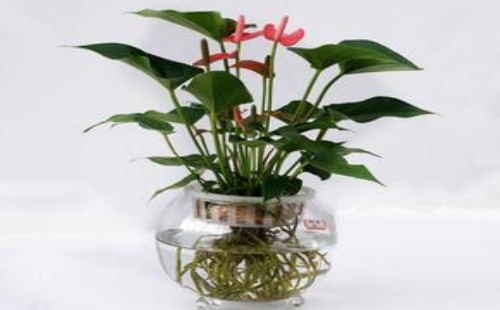
In fact, the roots of a hydroponic anthurium turning green does not mean the root system has rotted. In most cases, it is due to a poor underwater environment that has bred a large amount of algae and other debris wrapping around the root system. And this debris will greatly reduce the anthurium root system's ability to breathe, and even affect its normal absorption function, thereby affecting the plant's normal growth and flowering. So, we need to promptly clean away this debris wrapped around the root system. At the same time, we also need to do a good job in the following aspects of management:
1. Because the anthurium is grown hydroponically, the water must be changed frequently, especially in the hot summer. In summer, the clean water can be changed once every 3-5 days; in spring and autumn, it can be changed once a week; in winter, it can be changed once every 2-3 weeks. Moreover, each time the water is changed, the debris on the anthurium's root system must be promptly cleaned off, and the debris on the inner wall of the container must also be removed at the same time.
2. The water quality used for changing the water must be clean. Generally, purified water or mineral water is the first choice, followed by rainwater and tap water. Of course, if tap water is used, it needs to be left to stand for 2 days in advance so that the dissolved chlorine in the water fully evaporates before use.
3. During the water-changing process, if some roots are found to have turned black, rotted, or show similar phenomena, they need to be promptly cut off and cleaned away. After all, such roots are usually mixed with algae and other substances due to the respiration and metabolism of the anthurium's underwater roots, making them quite prone to turning green, turning black, rotting, and showing similar phenomena. So, each time the water is changed, they must be promptly cleaned away.
4. Generally, for a hydroponic anthurium, only 1/3-2/3 of the root system needs to be submerged below the water surface, and by no means should all the roots be submerged in the water. Otherwise, once the underwater roots have their breathing affected because they are wrapped in debris, it can easily cause the roots to turn green. Leave part of the root system in the container above the water surface. When the roots below the water cannot breathe normally, the roots above the water breathe oxygen from the air, so the plant's normal growth will not be affected.
5. A hydroponic anthurium should have its water changed frequently to ensure the water quality in the container is clean, but it is recommended to drip a few drops of nutrient solution each time the water is changed. Be sure to keep the concentration low, and be sure to drip in only a small amount. Especially when the temperature is too low or too high, the concentration of the nutrient solution should be reduced even further, and it may even be better to not use nutrient solution at all and only use clean water for growing. This can also avoid adverse phenomena such as the anthurium's root system turning green.