Can hydroponically grown Anthurium be converted to soil culture?
The leaves of the Anthurium are lush and dripping with green, and its flowers bloom a fiery red; the pairing of red and green is very eye-catching, so potted Anthurium has very high ornamental value and is also very practical. Moreover, the Anthurium has a certain tolerance for shade, and at the same time it is an evergreen plant that can bloom continuously, so it is very suitable to be placed in a bright spot indoors to accent a space or to be admired; it often brings people a feeling of delight and makes them feel very pleasant.
Not only that, the Anthurium can be grown both hydroponically and in soil. But whether hydroponic or soil-grown, as long as our care methods are appropriate and our management measures are in place, we can often grow it with abundant flowers and lush leaves. The hydroponic and soil cultivation of the Anthurium are merely two different ways of growing it, and there are also certain differences in the technical requirements. So, can hydroponically grown Anthurium be grown in soil?
In fact, hydroponically grown Anthurium can not only be converted to soil culture, but when grown in soil, the Anthurium often grows somewhat better than in hydroponics, and its care and management also appear somewhat simpler. Generally, the method of planting hydroponically grown Anthurium into soil for soil culture is relatively simple: you only need to take the plant out of the water-grown state, then plant it in a pot filled with something like peat soil, and after watering it thoroughly once, place it in a cool place to recover.
When converting hydroponically grown Anthurium to soil culture, the recovery process is very critical; after all, the plant suddenly moves from one growing environment to another, and there is a process of adapting to the new environment. This adaptation process generally takes 2-3 weeks. Once the Anthurium has successfully taken root and become established in the soil environment, we can carry out normal soil-culture management. Generally, it is enough to place it in a bright or sunny environment where it can receive scattered light, and to do a good job with water and fertilizer management as usual. Watering especially: because when the Anthurium lacks water, its stems and leaves tend to droop, but overwatering should also be avoided, and the environment must be kept ventilated, otherwise it may also cause root rot.
However, in order to help hydroponically grown Anthurium better become established and survive after being converted to soil culture, some detail handling should draw enough of our attention. Before soil culture, take the Anthurium out of the water, then trim the roots appropriately, and soak the roots in potassium permanganate solution or carbendazim dilution to sterilize and disinfect them, then rinse the roots with clean water, and then plant them in a pot. But the Anthurium is not suitable for planting in ordinary soil; it is recommended to use peat soil for potting and growing.
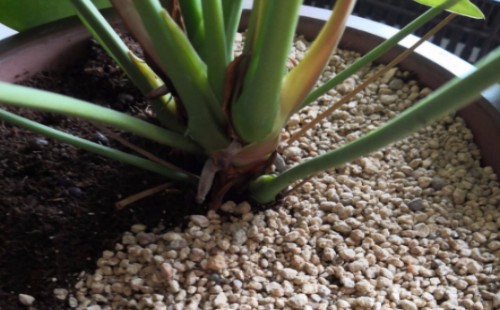
For the pot used, it is best to choose a ceramic pot or a purple clay pot, with a diameter of 18-28 cm, and before use the pot also needs to be sterilized, disinfected and soaked so that it fully absorbs water. Since the Anthurium prefers a slightly acidic soil environment, it is generally suitable to keep the pH value between 6.0-6.5. The growing medium requires good permeability and also a certain ability to retain water and fertilizer, so a mixed substrate of peat soil and perlite is recommended.