Is it better to grow Anthurium in water or in soil? A comparative analysis of the two care methods
Potted anthuriums are grown mainly for their flowers and foliage, but placing them indoors also serves to accent the home environment and purify indoor air, making them very practical. The anthuriums people commonly see are soil-grown, but in fact anthuriums can also be grown in water. However, whether grown in soil or in water, anthuriums often require us to master scientific methods. So, is it better to grow anthuriums in water or in soil?
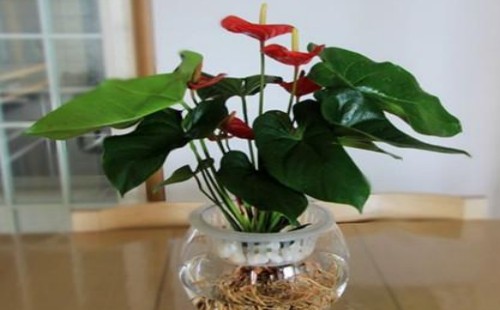
Generally, the anthuriums people commonly see are grown in flower pots with potting soil, but because of the soil, they often seem not so easy to care for; after all, soil tends to dirty the environment. With water growing, the environment often appears cleaner and more hygienic, and as long as a good container can be provided, the overall ornamental appeal of the anthurium seems somewhat higher. Perhaps for this reason, growing anthuriums in water is becoming increasingly popular with the public.
However, if the water-growing method is used to cultivate anthuriums, it often demands higher technical skill than soil growing. To promote rapid rooting in water-grown anthuriums, an induction method can be used to prompt the plant to sprout new roots, and the roots are also relatively strong in vitality. Once a water-grown anthurium has successfully rooted, care and management become much easier. But to ensure the anthurium can root smoothly during water growing, besides choosing a robust, healthy plant, it is usually also necessary to use agricultural streptomycin to disinfect and sterilise it, and nutrient solution is also needed for acclimatisation treatment.
For gardening friends growing anthuriums for the first time, soil growing is generally still recommended; after all, soil makes it easier to root and survive, and the technical requirements are relatively lower. Moreover, with soil growing, as long as the nutrients in the potting medium are sufficient, it is often more suitable for the anthurium's growth. But we also need to note that the anthurium is an epiphytic plant, and ordinary soil generally cannot grow it well; a medium rich in nutrients such as peat soil or coconut coir is usually used for cultivation. Of course, if some perlite or crushed wood shavings and similar materials can be added to the growing medium to improve the soil's permeability, the anthurium's growth results will be even more pleasing.
From the above analysis it is not hard to see that whether it is better to grow anthuriums in soil or in water is entirely decided by individual needs and preferences. Water growing appears healthier and more hygienic, and the plant grows more delicate with higher ornamental value, but it often demands higher technical skill; soil growing of anthuriums has relatively lower technical requirements and is very suitable for beginner gardening friends. But whether grown in soil or in water, we all need to conscientiously do a good job of care and management, otherwise everything is in vain.