Reasons Why Bougainvillea Branches Grow Thin and Long Without Blooming, and How to Fix It
Many gardening friends who like growing bougainvillea in pots have encountered the situation where the plant's branches grow thin and long, producing only leaves and no flowers. But friends familiar with bougainvillea know that this flowering plant has a rather peculiar phenomenon: when it blooms, it does not grow leaves, and when it grows leaves, it does not bloom. If the branches grow thin and long without differentiating flower buds, then pruning work at this time becomes very important.
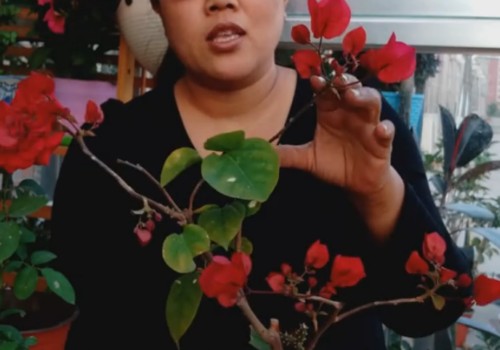
Generally in this situation, it is very necessary to prune the plant, but the pruning usually means cutting the branches back short, not cutting all the branches off. And after cutting the branches back short, you usually only need to keep about 3 pairs of leaves on each branch, that is, 2-3 pairs of bud points. Then cut off all the other parts to save nutrients, and when the nutrients accumulate to a certain level, flower buds will naturally form.
Of course, besides pruning, water control is also a very key measure for promoting flower bud differentiation in bougainvillea. Generally, you need to wait until the bougainvillea leaves begin to feel soft, or even slightly wilt, before watering it a little. And you should repeat the water control for about 1 month, as only this can achieve the effect of forcing buds through water control.
But to get bougainvillea to form flower buds, and even to bloom smoothly later on, nutrients cannot be lacking, so 1 month before adopting water control to force buds, you should also appropriately apply some phosphorus and potassium fertilizer to the plant. Topdressing is generally done once a week, diluted at a ratio of 1:1000 and poured onto the bougainvillea, or applied as a foliar spray. This is also very beneficial and necessary for promoting flower bud differentiation in bougainvillea.
But if the bougainvillea is exposed to overly strong light or excessive water control, yellow leaves can also appear. In this case, there is no need to worry; as long as the plant's root system is fine, even yellowing leaves will not have much impact on growth, and we only need to promptly improve our care measures to let it return to normal.
However, as long as the direct light is not especially strong, we still need to provide the plant with plenty of light, because bougainvillea blooming often requires that the more sufficient the light, the greater the flowering amount and the more vivid the flower color. And many varieties of bougainvillea generally bloom once in spring, and once during the winter-spring period after water control in autumn. But many varieties can also keep blooming in all four seasons when growing conditions are suitable and care management is in place.
Therefore, while fertilizing and controlling water to force buds, we should also clearly understand what variety of bougainvillea we are growing, and then carry out care and management according to its growth habits and characteristics, so as to ensure that it can smoothly achieve flower bud differentiation and bloom on schedule.